


After months of strong gains, Bitcoin has finally taken a breather. From a recent peak of around US $125,000, it has slipped to about US $107,000 — a decline of nearly 15%. The pullback came shortly after Donald Trump’s surprise announcement of a 100% tariff on Chinese imports, a move that reignited trade tensions and shocked the financial markets.
While we all know that volatility is part of Bitcoin’s DNA, the question in everybody’s mind is: “Is this just a healthy pause, or the last gasp?”
In this article, I will walk you through what’s really going on, why it matters — and what you should pay attention to.
Note that the information below is my personal opinion for educational purposes only, not financial advice.
The Big Picture First
When Bitcoin first broke into public consciousness in 2013, the idea was bold: a fully digital currency for instant, anonymous payments — no banks required. Its price surged that year from around US$13 to US$747.
Twelve years on, it has surpassed US$125,000. Thousands of personal fortunes have been made (and lost) along the way. Despite all the “going mainstream” talk, Bitcoin has never really challenged conventional currencies to pay for groceries, buy cars or send money across borders in mainstream fashion.
So what gives Bitcoin its value?
It’s not like owning a share that pays dividends or a bond that pays interest. Mainstream Bitcoin supporters believe:
There’s a finite supply – Bitcoin’s protocol limits the total coins to 21 million.
The issuance rate slows over time — roughly every four years, the “halving” reduces new supply growth. (The last halving was in April 2024).
Bitcoin is viewed as a hedge against traditional currencies, whose value can erode when central banks print money.
These dynamics mean most people who own Bitcoin today aren’t using it to buy goods. They’re holding it as an alternative asset, just like your stocks and bonds, believing in its scarcity value and future potential.
What Triggered the Recent Correction?
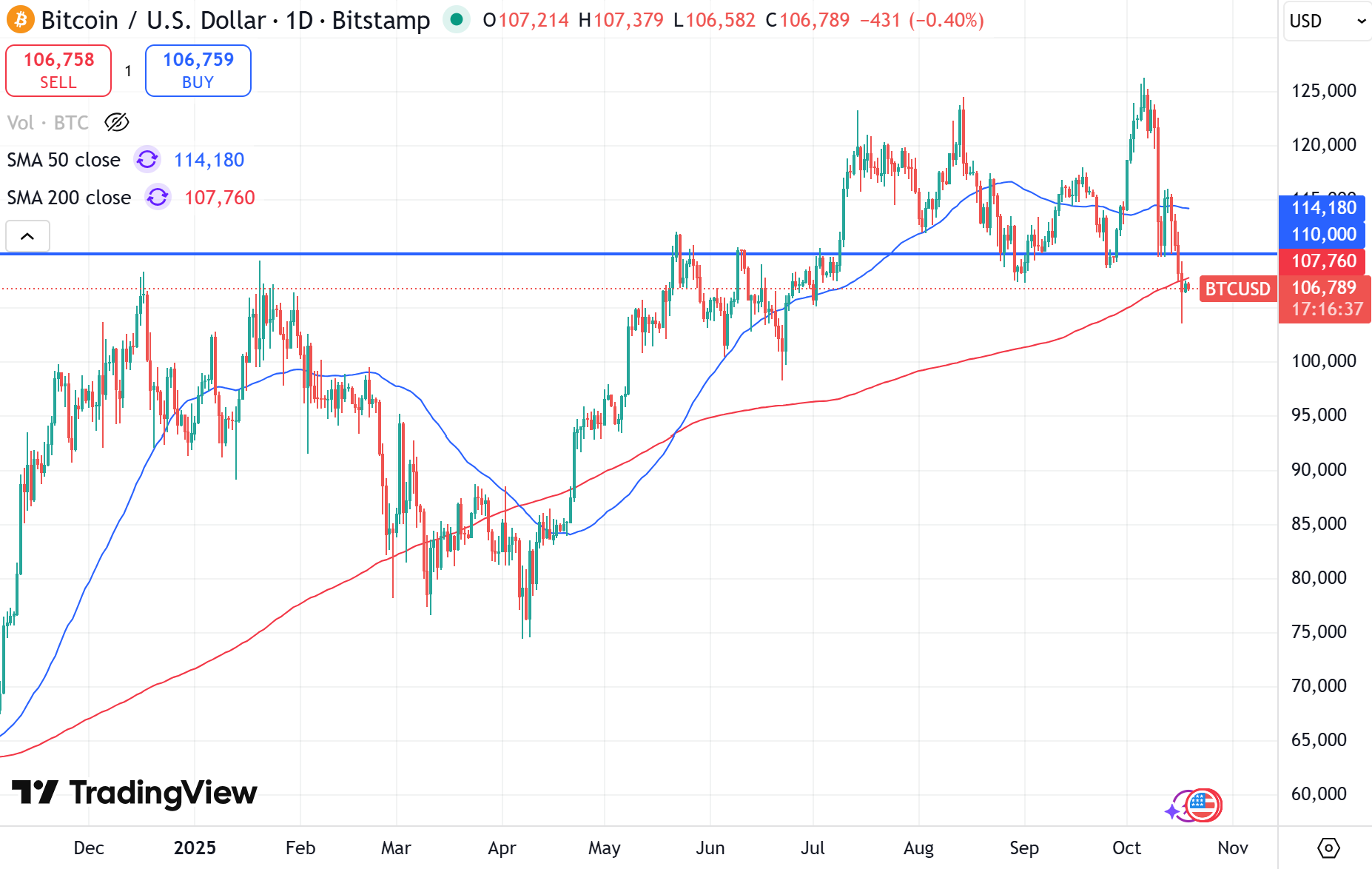
The recent pullback rattled the market because Bitcoin broke through the widely watched support level at US$110,000. Technical traders and short-term speculators believe the price could drift lower toward the next support zone.
But instead of focusing only on charts, let’s take a step back and look at the fundamental reasons behind this correction.

#1. Politics, leverage & forced selling
On Friday, October 10, the crypto market saw what analysts called the largest liquidation event in history, with more than US$19 billion wiped out from leveraged bets.
When Trump’s tariff announcement rattled global markets, the initial knee-jerk reaction of the crypto prices forced many leveraged traders to unwind their positions.
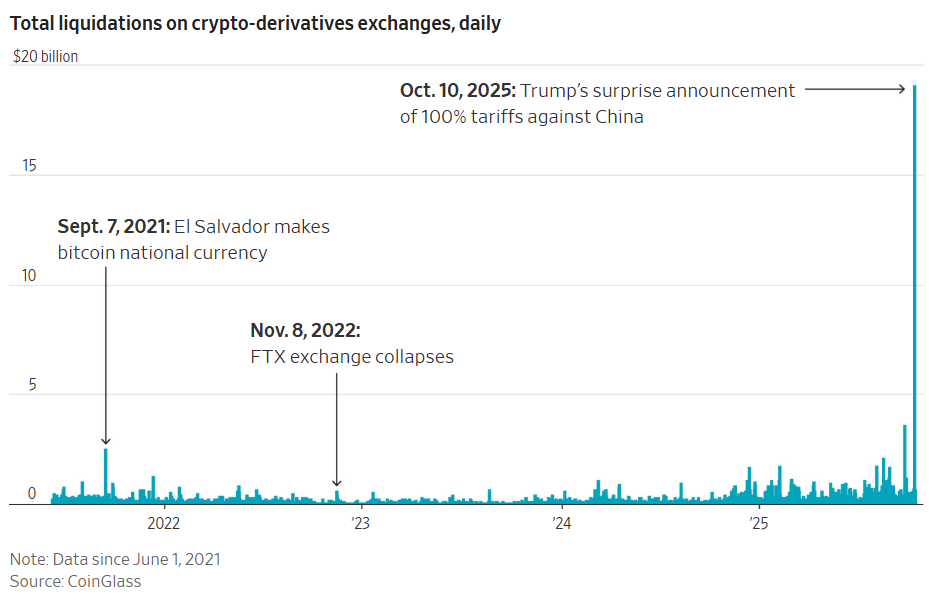
The result: a chain reaction of stop-losses and liquidations in derivatives markets, making the drop steeper than it might have been otherwise.
The real damage isn’t just in the price drop — it’s in the evaporation of liquidity and the erosion of market confidence that follows. It exposes an ecosystem still driven more by speculative momentum than by sustainable, utility-based growth.
I think what’s more important— and worth thinking about — is how closely financial markets are now intertwined with geopolitics. Prices no longer move just on fundamentals; they swing in response to policy decisions made by leaders who may themselves hold significant stakes in the very assets their actions influence.
#2. Macro risk-off sentiment
The global market environment has turned increasingly cautious amid escalating trade tensions, widening government deficits, and stretched stock market valuations.
According to the IMF’s latest Global Financial Stability Report, asset prices — particularly in equities and corporate credit — appear “fairly stretched” despite signs of economic slowdown. The surge in enthusiasm around AI mega-cap stocks has driven record market concentration, raising the risk of a “sudden, sharp correction” if future returns fail to meet lofty expectations.
As the IMF put it,
Beneath the calm surface, the ground is shifting in several parts of the financial system, giving rise to vulnerabilities… Valuation models now show risk-asset prices well above fundamentals, increasing the likelihood of disorderly market corrections should an adverse shock occur.
As risk sentiment retreats, speculative assets like Bitcoin tend to suffer first. While Bitcoin is often labelled “digital gold”, I’ve been telling clients it behaves more like a risk-asset barometer — when risk appetite falls, crypto typically follows.
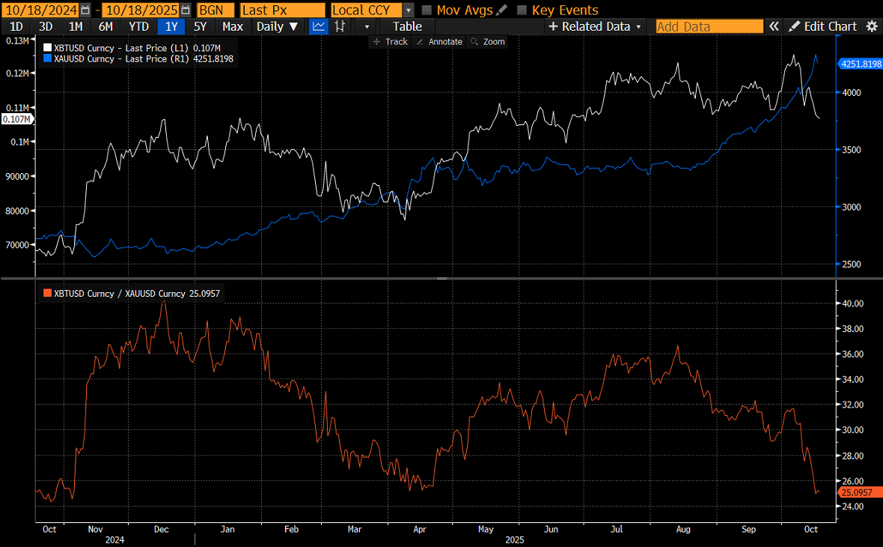
During the recent correction, the Bitcoin/Gold ratio also told an interesting story.
Gold = Fear. Bitcoin = Greed.
In simple terms, when the ratio rises, it means confidence and risk appetite are strong; when it falls, fear is taking over. This ratio — which measures how many ounces of gold are needed to buy one Bitcoin – fell sharply. This shows that investors were rotating from speculative assets into traditional safe havens.
#3. Technical breakdowns and mechanical selling
On the charts, Bitcoin broke below a key support level around US $110,000, triggering a wave of stop-loss orders and forced liquidations. The selling pressure was amplified by today’s algorithm-driven trading systems, which react automatically to price movements without considering fundamentals.
In such an environment, once a critical level is breached, machines sell first and ask questions later. Combined with leverage unwinds, this creates a feedback loop — where technical triggers accelerate declines far beyond what fundamentals alone would justify.
#4. Cooling ETF Flows — But Not a Panic Exit
One of the best indicators of market sentiment is ETF flows into spot Bitcoin funds, which serve as a good proxy for investor appetite. In the week following Trump’s tariff announcement, Bitcoin ETFs recorded about US $1.22 billion in outflows, coinciding with Bitcoin’s drop to a four-month low.
That number sounds alarming at first glance — but context matters. Just a week earlier, Reuters reported that Bitcoin ETFs had seen record inflows of US$3.55 billion in a single week. So $1.22 billion isn’t really alarming.
I don’t fully agree with the mainstream narrative that investors are fleeing Bitcoin in a mass exodus. I think what we’re seeing looks more like profit-taking and portfolio rebalancing after an extended period of strong gains.
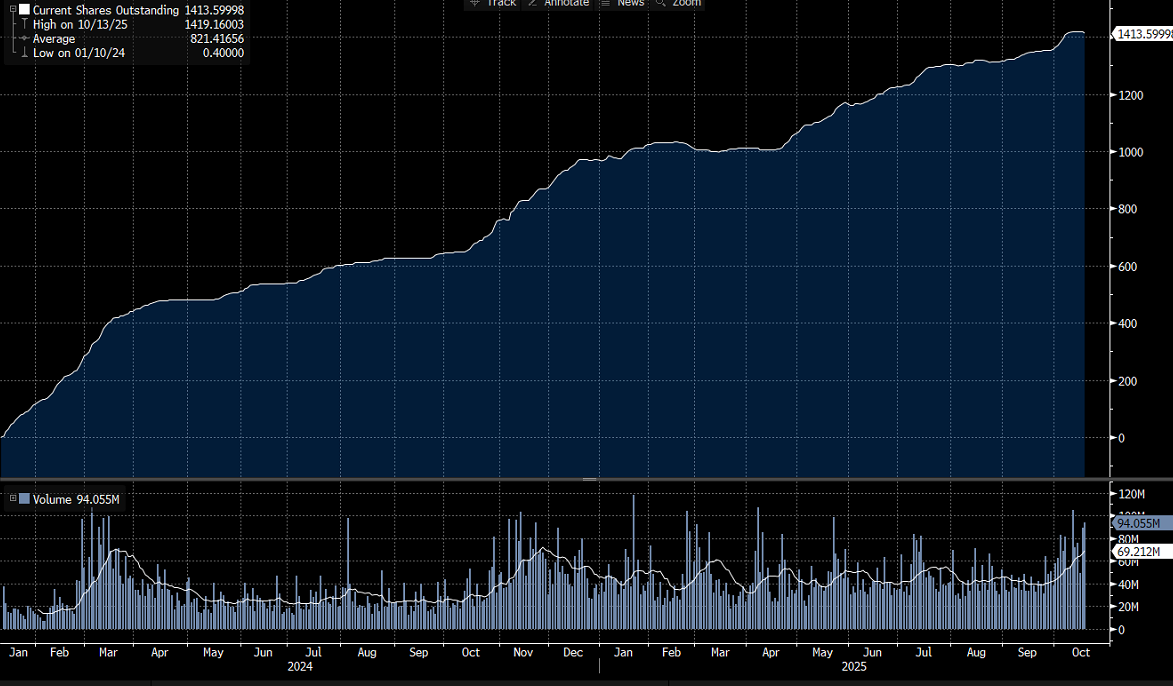
If we zoom in on the data — IBIT, the most actively traded spot Bitcoin ETF, still shows outstanding shares near record highs, suggesting that long-term conviction remains intact, at least for now.
#5. The Fear Factor: Government Seizure of Bitcoin
Amid the market volatility, another development flew under most investors’ radar — but in my view, it’s an important one.
Just last month, in September 2025, UK authorities concluded one of the world’s largest cryptocurrency seizures: about 61,000 bitcoins (worth over £5 billion) confiscated from Qian Zhimin, also known as Yadi Zhang, a Chinese national behind a massive investment scam that defrauded more than 128,000 victims between 2014 and 2017. After fleeing to the UK, she allegedly converted her illicit proceeds into Bitcoin, which police later discovered during a 2018 raid at her London mansion.
Barely a month later, in October 2025, the U.S. Department of Justice announced an even larger haul — the world’s biggest crypto seizure to date. Authorities confiscated roughly 127,000 bitcoins (about US $15 billion) from entities linked to Prince Holding Group in Cambodia, chaired by businessman Chen Zhi (Vincent Chen). The coins were traced to a vast cyber-fraud and human-trafficking network behind global “pig-butchering” scams.
Why do these cases matter?
The events show how governments today are now far more capable of tracking, freezing, and seizing illicit crypto assets through advanced blockchain analytics and international cooperation. While these events don’t change Bitcoin’s fundamentals, they do affect market psychology in several ways:
They remind investors that crypto is not beyond government reach.
They raise regulatory and enforcement risk, especially for large holders and unregulated exchanges.
They add to the “fear” narrative in a market already jittery over macro uncertainty.
This is no surprise to me. In my articles written in 2021, here is what I wrote:
At the end of the day, no matter how powerful you are, nobody is bigger than the government and the country where they stay. – Bitcoin: Is It a Good Long Term Investment?
Below was a follow-up article.
Nobody is bigger than the regulator. You can’t #defi or challenge the sovereignty of a country’s financial system. – What is The Future of Bitcoin
Of course, many things have changed since then, but I believe these principles will not change.
These events may not be the main cause of Bitcoin’s correction, but I believe they likely added another layer of caution, particularly among large investors already reassessing their risk exposure.
Final Thoughts & Key Takeaways
I’m not here to predict whether Bitcoin will shoot up tomorrow or drop further. What I can say is this:
Treat crypto as a “bonus income” layer – Given its volatility and behaviour, I position crypto in the “bonus income” layer in my “Kueh Lapis Retirement™” framework — after your guaranteed and variable income layers are secure.
Mind your position size and leverage – If you’re investing in crypto or stocks, make sure you have enough buffer so you won’t be forced to sell during a market downturn — because once you’re out, even if the market recovers later, the rebound has nothing to do with you.
Stay inside regulated platforms – Use exchanges or platforms that meet MAS regulations and ensure you know where your coins are stored, how custody works, and what protections (or risks) apply.
Use the correction as a checkpoint – pullbacks are a normal part of the crypto cycle and, historically, often set the stage for the next move up. But that only works if you’re prepared for the risk and volatility that come with it. Take this opportunity to reassess your risk tolerance and identify the areas you may not fully understand before the next wave begins.
- Stick to a portfolio approach — crypto should complement, not replace, your core holdings in equities, bonds, or real estate for your retirement. It’s meant to add optionality, not dominate your retirement plan.
Years of experience have taught me one simple truth — market bottoms are only visible in hindsight, and even the strongest uptrends must pause, consolidate, and reset before the next leg higher. That’s why successful investors stay disciplined and consistent, holding firm to their strategy even when the noise is loud and confidence is tested.
If you found this article helpful, share it with someone who might benefit too. For more insights like this, subscribe to my Retire Rich Weekly newsletter and join my Telegram Channel for timely updates and market perspectives.
Stay invested — and stay smart.