


The Central Provident Fund (CPF) is super important for retirement planning in Singapore, but a lot of folks don’t make the most of it. With some big changes coming to the CPF Special Account in 2025, it’s time to think about how you manage your CPF.
The biggest change? CPF Special Account will be closed when you hit age 55, and the balance will be transferred to your CPF Ordinary Account (OA), after setting enough for a Full Retirement Sum. Sounds confusing?
Read this update: CPF Special Account Closure: Navigating the New CPF Landscape.
In a nutshell, you’ll likely have more money in your OA than you expected when you turn 55. And this may not be what you wanted. Why? Let’s dive into what this means and what you can do.
CPF Shielding and Interest Rate
The CPF Board provides an almost guaranteed interest rate for your savings, which has remained stable for many years. There was a minor adjustment of 0.01% to CPF interest rates in 2023 in response to global interest rate hikes. The base interest rate currently stands at 2.5% for the Ordinary Account (OA) and 4% for the Special Account (SA).
Previously, the concept of “CPF Shielding” was popular among individuals nearing retirement, as it allowed their CPF funds to remain in the SA account to accrue higher interest. However, this option is no longer available starting this year, as the CPF Special Account will be closed for members above the age of 55.
What can you do with the additional balance in your CPF OA?
Option 1: Do nothing: Keep savings in OA and continue as usual.
Option 2: Transfer: Move CPF OA to CPF Retirement Account (RA) up to the Enhanced Retirement Sum (ERS). This earns a minimum guaranteed 4% interest, resulting in higher monthly CPF Life payouts. The current limit is $426,000 in 2025.
Option 3: Invest: Use the CPF Investment Scheme (CPFIS) to invest for potential higher returns. In Singapore, you can only invest your CPF in the approved financial instruments. What are they? How to invest? In this article, I will explain your options.

Should you invest your CPF in the first place?
A lot of people don’t know that they can invest their CPF funds to potentially get higher returns. Some online sources say to avoid CPF investments because the interest you earn is already good enough, and suggest focusing on investing cash savings instead.
But if you think about it, CPF interest is considered a “risk-free” return, which doesn’t mean you should miss out on investment opportunities.
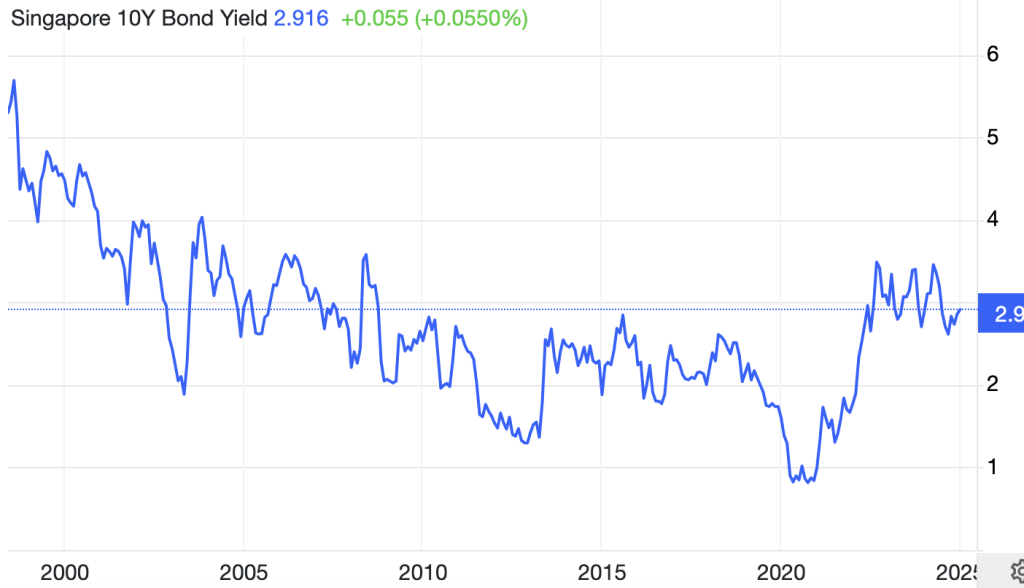
Take a look at Singapore’s 10-year government bond yield history, for example. It went over 5% in the early 2000s. That didn’t mean investing was a bad idea back then.
The primary distinction is that, given the risk-free interest provided by your CPF, you should set a higher “required rate of return” for your CPF investment.
To invest using your CPF, you need to open a CPF Investment Scheme (CPFIS) account. Remember, returns earned will go back to your CPF accounts, so consider long-term benefits.
It’s a myth that you must repay CPF if you lose money on investments. Unlike property purchases with CPF, where accrued interest must be paid when selling, investment losses don’t require repayment.
What is the CPF Investment Scheme (CPFIS)?
The CPF Investment Scheme (CPFIS) allows you to invest your Ordinary Account (OA) and Special Account (SA) savings in a wide range of investments with the potential to earn higher returns than the CPF interest rate for your retirement. You can invest your CPF savings in various instruments such as insurance products, unit trusts, fixed deposits, bonds, and shares.
The history of CPF investment dates back to 1986 when Ordinary Account Savings were first allowed to be invested under the Approved Investment Scheme. Over time, the scheme evolved into what is now known as the CPF Investment Scheme (CPFIS). To mitigate excessive investment risks, limits were established on the amount of investible funds and the types of financial instruments.
Getting Started with Your CPF Investment
You can invest under CPFIS if you:
- are at least 18 years old;
- are not an undischarged bankrupt;
- have more than $20,000 in your OA; and/or
- have more than $40,000 in your SA; and
- have completed the CPFIS Self-Awareness Questionnaire (SAQ) (applicable to new investors with effect from 1 October 2018)
You can either make investment decisions independently, or you can engage a financial adviser to assist you.
In either case, you must first open a CPF Investment Account with DBS, OCBC, or UOB if you intend to invest your Ordinary Account savings. These banks act as the “agent bank” responsible for administering your CPF funds.
Before opening a CPF Investment Account, it is mandatory to complete a Self-Awareness Questionnaire (SAQ) at CPF website. This requirement helps you understand:
- Investment concepts such as the risk-return relationship.
- Considerations before investing.
- Investment products and charges under CPFIS.
Although the banks are authorized to withdraw your money from CPF and allocate it into investment vehicles, it does not imply that you must purchase investment products from these banks.
Furthermore, there is no need to open a CPF Investment Account if you wish to invest your Special Account savings.
The cost-effective way is to transact your CPF investments through a CPF Investment Administrator (I will explain later), particularly if most of your investments are in funds.
What can you invest in using your CPF?
Under the Central Provident Fund Investment Scheme (CPFIS), you are eligible to invest your Ordinary Account (OA) savings once you have set aside $20,000 in your OA, or your Special Account (SA) savings after setting aside $40,000 in your SA.
It is important to note that there are distinct requirements for the balances of these two accounts, as they pertain to different CPF investment schemes:
- The CPFIS-Ordinary Account (OA) and
- The CPFIS-Special Account (SA).
The following table shows the specific instruments approved by the CPFIS-OA and CPFIS-SA in which you may invest:

Take note that up to 35% of investible savings can be invested in:
- Shares
- Property Funds
- Corporate Bonds
And up to 10% of investible savings can be invested in:
- Gold ETFs
- Other Gold products (such as Gold certificates, Gold savings accounts, Physical Gold)
Additionally, you can invest in other Gold products (such as Gold certificates, Gold savings accounts, and/or Physical Gold) using your Ordinary Account savings. However, investments must be made through UOB, and your CPF investment account must also be opened with UOB.
To provide clarity, here is an example:
If you have $200,000 in your CPF-OA (total investible savings) and withdrew $80,000 for housing, you would have $120,000 remaining in your OA. After setting aside the $20,000 that cannot be touched, the amount available for investment is capped at $100,000 ($120,000 – $20,000).
There are sub-limits for shares and gold investing:
- For stocks (up to 35% of investible savings), you can invest up to $42,000.
- For gold (up to 10% of investible savings), you can invest up to $12,000.
However, if you were to invest in unit trusts, you can utilize the full $100,000. We will talk about the unit trust options later.
Let’s go deeper to each of the options
Invest Your CPF Savings in Fixed Deposits
Currently, four banks are approved by CPF to offer fixed deposit products:
- DBS Bank Ltd
- Maybank Singapore Limited
- Oversea-Chinese Banking Corporation Ltd (OCBC)
- United Overseas Bank Ltd (UOB)
In the past, when interest rates were below 1%, it made little sense to invest CPF savings in fixed deposits or Singapore government bonds due to their low returns. However, with higher interest rates in recent years, there was a brief period when banks reintroduced fixed deposits for CPF OA in early 2024.
Unfortunately, following the Fed rate cuts last year, none of these banks currently offer fixed deposit options under the CPF Investment Scheme.
Invest Your CPF Savings in T-Bills and Singapore Government Bonds
It was popular to put your CPF OA savings into T-Bills and Singapore Government Bonds in 2024. These are some of the safest investments you can make since they’re backed by the Singapore government.
Do note Singapore Savings Bonds (SSB) are not eligible under the CPF Investment Scheme.
Currently, T-Bills offer better returns than the standard 2.5% CPF OA interest rate. You can purchase T-Bills through any of the three CPFIS agent banks online.
However, it’s essential to understand that CPF calculates interest based on the lowest balance of the month, not the average balance.
This means that if you use CPF OA to buy T-Bills, any withdrawals or deductions made during the month will not earn interest for that month. Similarly, any contributions and refunds received will only start earning interest in the following month. As a result, you may not actually earn a higher overall interest by investing in T-Bills compared to leaving your funds in the OA.
Invest Your CPF Savings in Insurance
There are several insurance products available for investment. While endowment plans were once popular, most insurers now predominantly offer investment-linked policies.
This shift is due to the fact that guaranteed returns from traditional insurance products are typically lower than the risk-free CPF interest rate. However, it’s well known that investment-linked insurance policies come with high costs, so I would advise against considering these products.
Invest Your CPF Savings in ETFs
Exchange Traded Funds (ETFs) have gained popularity in recent years, but there are still very limited choices of ETFs in a CPF investment. There are only six CPF-approved ETFs listed on the SGX:
- SPDR Straits Times Index ETF (SGX: ES3)
- Nikko AM Singapore STI ETF (SGX: G3B)
- ABF Singapore Bond Index Fund (SGX: A35)
- SPDR Gold Shares (SGX: O87)
- Nikko AM SGD IG Corporate Bond ETF (SGX: MBH)
- Nikko AM ST Asia ex Japan REIT ETF (SGX: CFA)
You can invest in ETFs through authorized stock brokers. No ETF is available as a Special Account investment for now.
You need to take note that you can only invest up to 10% of your investible savings in the Gold ETF.
Invest Your CPF Savings in Stocks
Not all stocks are eligible for CPF investments, and you can only invest in Singapore stocks using your CPF savings. To check which stocks you can invest in, go to this link on the SGX website. You will find a comprehensive list of stocks eligible under the CPF Investment Scheme, as shown in the image below.

It is important to note that you can only invest up to 35% of your investible savings from your Ordinary Account (OA) in stocks. Currently, no stocks are available for investment using your Special Account (SA) funds.
Invest Your CPF Savings in Unit Trusts
Unit trusts don’t have a good name in Singapore, mainly because it is the most mis-sold product here. Unfortunately, many people purchase a unit trust through banks or insurance agents who are commission-based advisers. Banks are the largest fund distributors in Singapore.
Think about it, a typical salesperson will only present you with a fund that has already performed very well in the past few years or one that is “hot” now. Just look at how many technology funds are being marketed aggressively today after their stellar run in the past 2 years. But will these performances continue or will you end up buying just before the tide turns?
I often hear complaints like, “I lost money in my CPF investment because I invested in unit trusts.” It’s akin to when a child bumps into a table, and parents blame the “bad table.” Blaming your investment losses solely on the unit trust is naive. It’s not the fund that lost your money; it’s the wrong underlying market you chose.
Additional reading: How to dig below the sales pitch for a unit trust.
In this article, I discussed famous hedge fund manager Ray Dalio’s investing “principles” and “ego investing.” Admitting mistakes is challenging for most people. Shifting blame irrationally to other people or products might pacify you in the short term, but it doesn’t solve the long-term problem.
If you look at the CPF Investment Options, it should be clear that setting up a global multi-asset investment portfolio without unit trusts is nearly impossible.
You may have noticed that your insurance agent and banker RMs have stopped pestering you to buy unit trusts using CPF. Why?
The CPF Board has taken measures to progressively lower the cost of investments and improve the quality of funds under the CPF Investment Scheme. The process started in 2006, and only recently, sales charges have been scrapped for all CPF investments. This makes unit trusts an even more appealing option.
If you are a DIY investor, finding the list of unit trusts approved by CPF is very simple. Go to FSM Fund Selector. Select “Payment Method” to be “Included Under CPFIS OA” and “Included Under CPFIS SA”, and then click the “Generate Funds Table” button.

You will get a list of funds as shown below.

Using CPF Investment Administrators to consolidate your investment
If you found your fund investments are in multiple accounts through multiple intermediaries such as brokers and banks, you are not alone.
How are you going to monitor your portfolio and do asset allocation if you don’t even have a global view of your holdings?
Luckily, you can use a CPF Investment Administrator to consolidate your fund purchases from various fund houses. This allows you to save costs and efforts, regardless of the number of fund houses you buy from.
There are currently 4 CPF Investment Administrators in Singapore:
- iFast Financial Pte Ltd
- Navigator Investment Services Ltd (owned by Singlife)
- Phillip Securities Pte Ltd
- UOB Kay Hian Private Limited
Submit a request for a non-obligatory investment discovery meeting if you want to understand how to consolidate your investments.
Should You Engage a Financial Adviser to Assist with Your CPF Investment?
In this article, I shared that surveys show people who engage financial advisers are more likely to achieve their retirement goals than those who don’t. However, this holds true only if you engage the right adviser. What do I mean by that?
The term “financial adviser” is used very loosely in Singapore. There are two main types of financial advisers:
- Commission-based
- Fee-based
As you may have noticed, most advisers from banks, insurance companies, and even financial adviser firms are commission-based. They “sell” a fund to you in exchange for the “sales charge” as their commission. Only a small percentage of financial advisers are fee-based.
A true fee-based financial adviser does not “sell” any funds. Their job is to manage your portfolios. As Charlie Munger wisely said, “Show me the incentive and I’ll show you the outcome.”
As a fee-based financial adviser myself, I’ve been practising this approach even before the CPF implemented zero sales charges. I believe that portfolio asset allocation is more important than stock picking or a buy-and-hold strategy. Only when the commission is removed from the relationship will you receive the best advice.
Let me summarize…
In this article, I’ve detailed all the investment options available under the CPF Investment Scheme. You have the flexibility to invest in CPF on your own or seek assistance from a financial adviser.
I compiled a Beginner’s Guide to CPF Investment, which you can download here.

As an independent financial adviser, I specialize in reviewing existing retirement plans and setting up tailored investment portfolios. If you’re looking for an unbiased review and personalized advice for your CPF investments, feel free to submit your application using the form below for a no-obligation discovery meeting.
If you find this article useful, join our Telegram channel or subscribe to my weekly newsletter to retire rich by investing wisely.