


“Latest Singapore six-month T-bill cut-off yield sinks to 2.05%“, that is Singapore’s Business Times headline this week. This result, based on the auction this Thursday (Jun 5), was a further decline from the 2.2% cut-off yield offered in the previous six-month auction that closed on May 22.
This broader trend is something I’ve been highlighting since the end of last year, besides the T-bill,
- The latest 10-year average SSB yields have dropped to 2.49%
- UOB and OCBC have cut their savings account interest rates, marking the end of high passive income from deposits
As discussed in my previous article, with interest rates trending lower, it’s time to rethink how to position your portfolio for stability and long-term returns.
If you’ve been relying on these short-term instruments for easy passive income, the reality is that this window of “easy money” is closing. The best move now? Lock in higher yields while they’re still available.
How to Navigate the Changing Interest Rate Landscape
If you’ve been following me for a while, you know that I invented the Kueh Lapis Income Strategy to build portfolios with a structured approach, layering various sources of income for stability and growth.
Yes, SSBs and fixed deposits provide stability at the base, but as their returns have diminished, longer-term bonds, such as the US Treasury, are becoming a critical part of income generation. Depending on your risk appetite, time horizon, and preferences, they can fit into either the guaranteed income layer or the variable income layer.
Regardless of where they fit, they add a distinct dimension to your portfolio, delivering strong yields and potential capital appreciation.
Why US Treasuries Make Sense Now
There’s been a lot of discussion lately about whether the US can continue meeting its debt obligations or whether markets are dumping US Treasuries. That’s a big topic for another day. Let me know in the comments if you’d like me to explore it further.
For now, let’s assume that Uncle Sam won’t—or can’t afford to—default on its debt, at least in the foreseeable future. If you agree with this premise, let’s examine why US Treasuries present an attractive opportunity right now.
Locking in High Yields While They Last
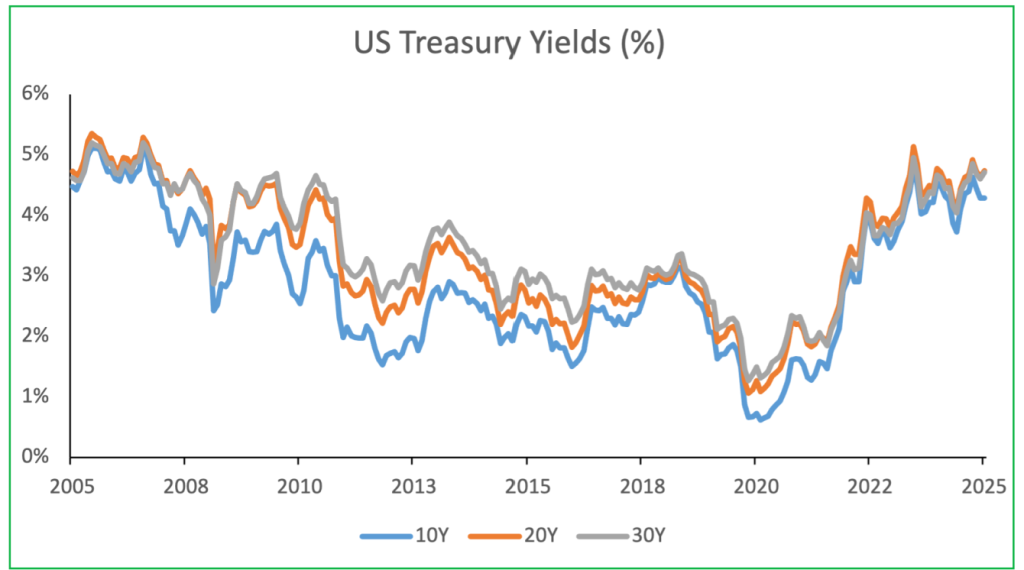
As you can see from the chart below, the current long-term US Treasury yield is the highest since the Global Financial Crisis in 2007, hovering around 5%. This is one of the best chances in almost two decades to lock in long-term returns at a meaningful rate.
Some may argue that investors should still buy the short-term treasury, citing that Warren Buffett’s Berkshire Hathaway is reported to now own 5% of the short-term T-bill market.
But let’s be honest—you and I are not Warren Buffett. Berkshire is a stock-focused investment firm that needs cash readily available for future opportunities. As an income investor, your priority is steady returns, not keeping cash on standby. So the real question is: do you want liquidity for opportunistic investing, or reliable income generation?
The US Treasury market is the largest and most liquid government bond market, trading over $600 billion daily. That level of liquidity ensures:
- Tighter bid-ask spreads, meaning lower transaction costs for investors
- Better pricing efficiency, whether you buy Treasuries directly or through a bond fund
Historically, it’s rare to find long-duration risk-free exposure with such attractive yields. Think about insurance companies, for example. They need to match their liabilities (payouts to policyholders) with suitable assets (underlying bonds). Would they pass up the chance to lock in high-quality bonds at 5%? Probably not.
Potential Capital Upside Through Mean Reversion
Interest rates move in cycles—what goes up will eventually come down.
Bond investing 101 teaches us that interest rates have an inverse relationship with bond prices. If rates decline, whether due to stabilizing inflation, a Fed policy shift, or a stock market downturn, Treasury prices will rise, and you will get potential capital gains on top of the coupon you receive.
Providing Stability During Market Volatility
Treasuries have always served as a strong buffer during economic downturns and periods of market stress.
- When volatility spikes, money flows into Treasuries, pushing prices higher
- Their negative correlation to equities makes them an effective hedge during market declines
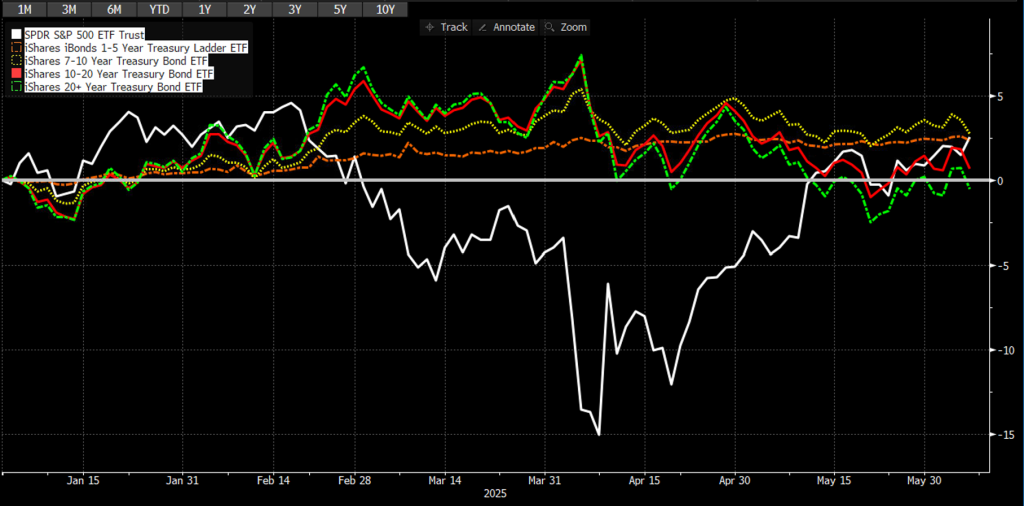
As you can see from the chart below, the negative correlation between Treasuries (ETFs with different durations) and equities (represented by S&P 500 ETF) was clearly demonstrated during the latest market crash in April, triggered by Trump’s “liberation day.” This reinforces their role as an effective hedge against stock market downturns.
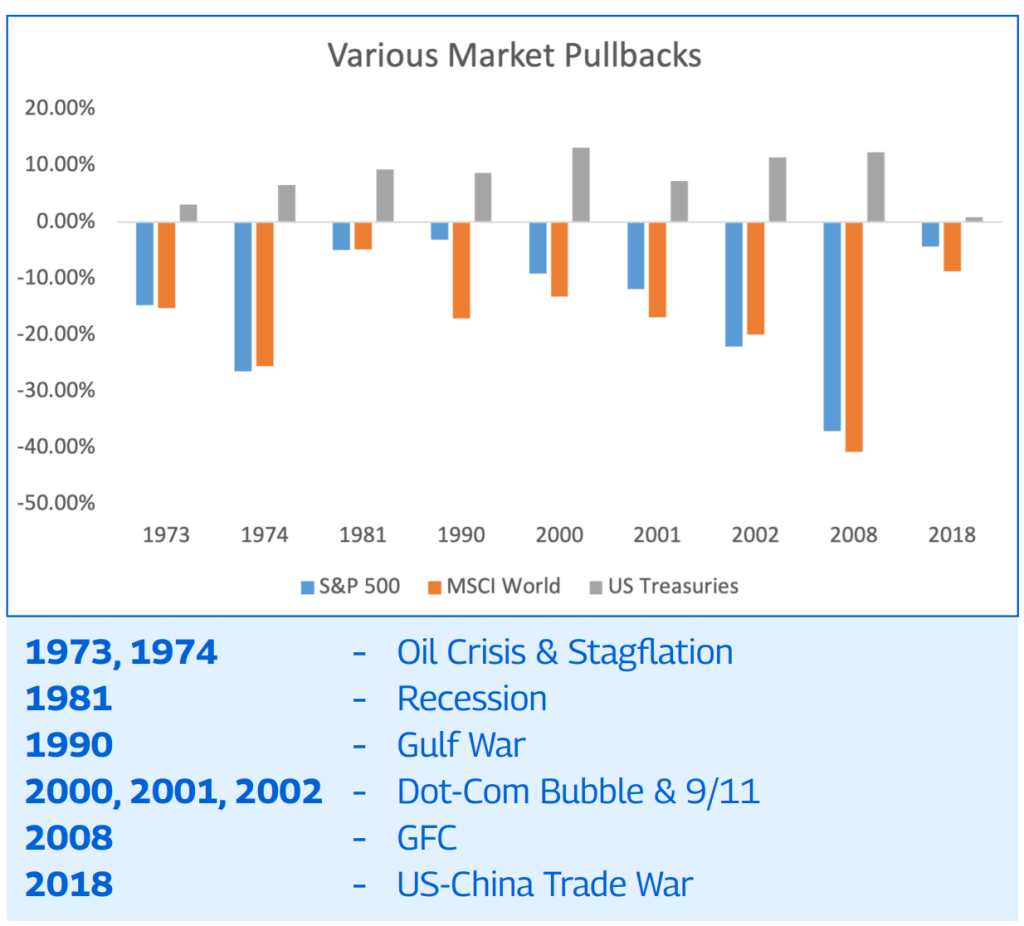
Historically, long-duration Treasuries have performed well during recessions, providing a stable and reliable safeguard for your investments when economic uncertainty rises. The data below shows the performance of US treasuries and stock markets in various market pullbacks.
I know some of you might ask: What about gold or Bitcoin as hedges? That’s a topic for another day—let me know in the comments if you’d like me to dive into it.
Be Mindful of Currency and Duration Risks
If you already hold USD and need USD-denominated income, investing in US Treasuries is straightforward.
But for Singapore-based investors, both currency risk and duration risk must be carefully evaluated when investing in US assets.
The USD has depreciated by 6% against the SGD year-to-date—that’s more than a year’s worth of interest lost due to currency fluctuations if left unhedged.
The solution? Utilize SGD-hedged instruments to mitigate currency fluctuations while ensuring your duration exposure aligns with your investment strategy.
However, hedging is not a foolproof solution—it comes at a great cost, and it’s a double-edged sword. If the USD suddenly rebounds and appreciates against the SGD, an unhedged position could turn out to be more beneficial.
It’s also worth noting that USDSGD is hovering near the 1.2800 level, a point last seen only recently and in 2014—more than a decade ago. A potential USD recovery is not out of the question.
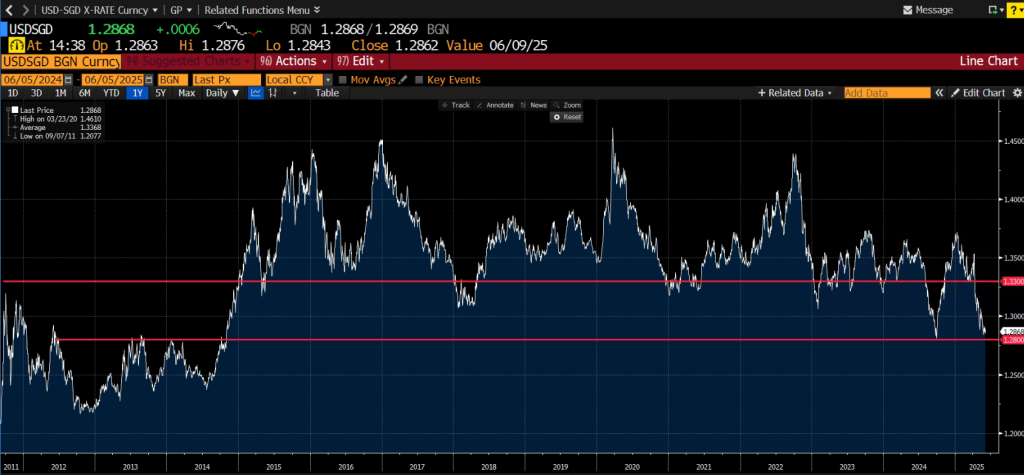
At the same time, duration risk is a key consideration when investing in longer-term Treasuries. These bonds are highly sensitive to interest rate fluctuations, meaning price volatility could affect returns if rates unexpectedly rise.
So what’s the right duration to invest in? Should you focus on bonds maturing in 1 to 5 years, 5 to 10 years, 10 to 20 years, or even longer?
While locking in higher yields now can be advantageous, it’s crucial to assess your investment horizon and risk tolerance to ensure you’re prepared for potential price movements over time.
Ultimately, the key is finding the right balance between risk, benefits, and total returns to ensure an optimized and resilient portfolio.
Final Thoughts
In my Kueh Lapis Income Strategy, different income sources are layered for balance and resilience.
- Guaranteed Income Layer: T-bills, SSBs, bank deposits, and CPF savings form the stable foundation
- Variable Income Layer: This is where long-duration US Treasuries fit in, offering higher yields and capital upside, especially when hedged to SGD. Other assets here include corporate bonds, REITs, preferred securities, stable dividend stocks, and structured products
- Bonus Income Layer: This is where “sexier” investments like Bitcoin and short-term stock trading come into play
With short-term SGD interest declining and deposit rates following suit, I believe locking in higher yields now is a sensible move. Long-term US Treasuries, when properly managed, provide a strong addition to this framework.
At this stage, you probably have a lot of questions:
- How can you buy a US Treasury?
- What duration should you look at?
- How to effectively mitigate the currency risks?
As a professional adviser, I specialise in crafting Kueh Lapis Income portfolios that balance stability, growth, and income, ensuring a resilient investment approach.
If you’re looking to capitalise on the US Treasury opportunity, you can apply for a non-obligatory investment discovery meeting via the form below. Let’s discuss whether this strategy aligns with your financial situation and how it can grow your wealth and achieve your financial goals.
And if you enjoy reading this article, don’t forget to share and subscribe to our email list below. You can also join our Telegram Community for further discussion.