


Interest rates are falling—again. If you’ve been wondering what to do with your idle cash or feeling anxious about shrinking returns from “high interest” savings accounts, you’re not alone.
Just a few months ago, many Singaporeans were still parking their idle cash in so-called “high interest” savings accounts, thinking it was a safe and smart move. And now, we’re seeing that shift to low interest rate environment unfold right before our eyes.
The question now is: how do you stay ahead of the curve and protect your income – even in a falling interest rate environment?
In this article, I’ll share how I approach income investing using my “Kueh Lapis Income Strategy”—layering different assets to build stable, long-term and sustainable returns.

For my clients and community members, you’ll know I’ve been consistently advocating a Kueh Lapis Income Strategy since the beginning of the year. Rather than chasing short-term yields such as T-bills or Fixed Deposits, I’ve been encouraging a shift towards locking in longer-term rates, especially as the signs of a falling interest rate environment became more apparent.
Banks are cutting interest rates fast
The trend became evident on 1 May 2025. According to the Straits Times article, both UOB and OCBC implemented significant interest rate cuts on their flagship savings accounts.
UOB One Account: The maximum effective interest rate was reduced from 4.0% to 3.3%. on balances up to S$150,000, assuming customers meet the criteria of crediting a monthly salary of at least S$1,600 and spending a minimum of S$500 per month on eligible UOB cards.
OCBC 360 Account: The maximum effective interest rate decreased from 7.65% to 6.3%. on the first S$100,000. The number looks high, but you have to invest and buy insurance from them. The most realistic rate for common savers dropped from 4.65% to 3.3%, if you fulfil the salary crediting, saving, and spending requirements.
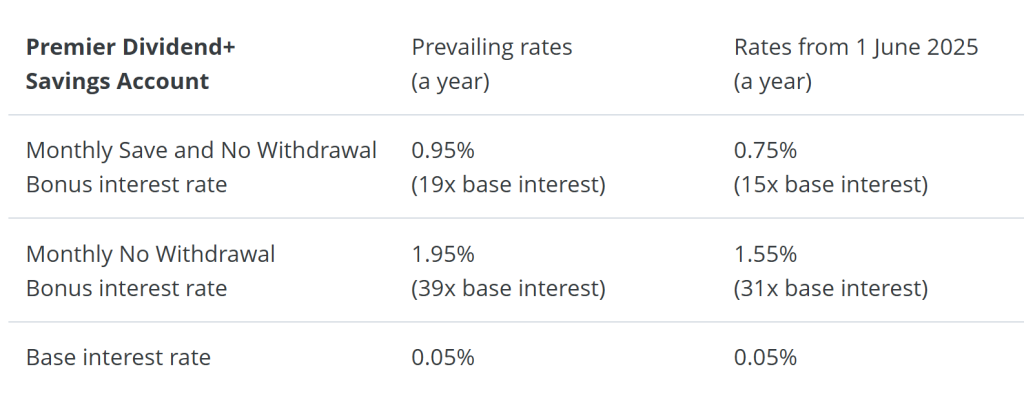
Starting 1 June 2025, OCBC Premier Dividend+ Savings Account, one of my favourite no-frill high-interest accounts, will be cutting its bonus interest rates. This is a further cut after the rate cut of the OCBC Premier Dividend+ Savings Account in January 2025.
Monthly No Withdrawal Bonus: From 2.20% → 1.95%
Monthly No Withdrawal & Save Bonus: From 1.05% → 0.95%
Base Interest Rate: Remains at a meagre 0.05%
So, the maximum interest you can earn drops from 2.95% to 2.35%.
T-bill and SSB returns are dropping too
The most recent 6-month Singapore Treasury Bill (T-bill) auction, conducted on 22 May 2025, concluded with a cut-off yield of 2.20%, making the fifth straight decline since March 2025.
The latest Singapore Savings Bonds (SSB) for June 2025 offer a 10-year average return of 2.56%, down from the highs of 3% + we saw in 2023–2024.
These adjustments reflect a broader market trend of declining deposit rates in Singapore. If you’re still relying solely on these accounts for higher returns, it’s time to reconsider your strategy. The window to lock in attractive yields is narrowing, and proactive steps are essential to maintain and enhance your investment income.
How to Maintain and Enhance Your Yield? The “Kueh Lapis” Approach
You’ve heard me say it before—I don’t believe in putting all your eggs (or kueh layers) in one basket.
Just like a well-made kueh lapis, your income strategy should be built on multiple, complementary layers—each playing a specific role in balancing yield, liquidity, and risk.
I developed the Kueh Lapis Strategy through years of experience as a financial adviser, helping clients build sustainable, resilient income portfolios. I’ve laid out the full framework in my book “FIRE Your Retirement“ and shared the philosophy behind it in this article.

Here’s how I apply the kueh lapis approach in today’s changing interest rate environment.
Layer #1: Optimize Your Cash Management
Before reaching for higher-yield or higher-risk instruments, always start with the foundation: your cash.
Ask yourself honestly—is your idle cash working hard enough for you?
In today’s environment of falling bank deposit rates and tighter spreads, many traditional “high-interest” savings accounts are no longer as attractive as they once seemed. Worse still, they often come with confusing criteria, such as mandatory salary crediting, minimum card spending, or balance caps, that can quietly erode your actual returns if not fulfilled.
Instead, I prefer to use Money Market Funds (MMFs) as a core tool for cash optimisation. Why?
Daily Liquidity – You can access your funds any time without penalties or lock-ups.
No hoops to jump through – No need to meet account conditions or tie up funds unnecessarily.
Competitive yields – Many MMFs are currently yielding better than typical bank savings, and they invest in high-quality short-term instruments.
MMFs can be a smarter holding place for both small and large cash positions, be it emergency cash or short-term reserves, giving you flexibility while still generating returns.
In the Kueh Lapis framework, this first layer serves as your liquidity buffer—stable, simple, and always ready when you need it.
✅ Pro Tip: Some investment platforms offer auto-sweep into money market funds, so your idle cash or dividends from your investments earn yield daily without manual effort.
Layer #2: Diversify Fixed-Income Exposure
Now that T-bill and SSB yields are falling, it’s time to look beyond them.
Government Bonds: Still good for safety, especially SSBs for flexible redemption. But don’t over-concentrate here.
Corporate Bonds: Consider investment-grade corporate bonds for steady yields with solid credit quality. For those willing to take on more risk, high-yield bonds can offer attractive returns. It’s important to note that not all high-yield bonds are “junk bonds.” The key lies in careful credit selection to balance yield and risk effectively.
Bond ETFs: Bond Index ETFs or Funds give diversified exposure to both government and corporate bonds. But pay attention to underlying components and currency exposure.
✅ Pro Tip: If you’re using CPF, there are CPFIS-approved bond funds worth looking at. And watch out for the fund with unhedged USD exposure, as the USD has been quite volatile against SGD recently.
Layer #3: Extend Duration Strategically
As interest rates decline, locking in longer-term yields now can be a smart move—especially if you’re planning for retirement or financial independence.
Instead of trying to time the market, I recommend using a bond ladder strategy. This means spreading your bond investments across different maturities (e.g. 1, 3, 5, or 10 years), so that parts of your portfolio mature at staggered intervals. This approach helps you:
Manage reinvestment risk – Not all your bonds mature at once, so you’re not stuck reinvesting everything during a low-rate period.
Maintain consistent income – You can structure your ladder to provide predictable payouts, which is extremely helpful if you’re relying on investment income.
Balance rate sensitivity – Longer-term bonds offer higher yields but are more sensitive to rate changes. Laddering helps smooth out that volatility over time.
This layer is particularly important for retirees and FIRE aspirants, who need both stability and visibility in their income streams over the next 10–30 years.
✅ Pro Tip: Longer-duration bonds do come with more price volatility when interest rates fluctuate. That’s why it’s crucial to match your investment horizon with your cash flow needs—and to stay calm when prices move. If you’re planning to hold to maturity, these short-term market fluctuations often don’t matter.
Layer #4: Explore Alternatives
If you’re looking to boost your income beyond what traditional bonds and deposits offer, you may want to explore alternative fixed-income instruments. These aren’t for everyone, but if you understand the risks and structure them properly, they can become powerful additions to your income portfolio.
This layer of the kueh lapis strategy is designed for investors who are willing to accept a bit more volatility in exchange for higher yields. Here are some tools worth considering:
- Floating Rate Notes (FRNs) – FRNs are bonds where the coupon payments adjust periodically based on a reference rate, such as SORA, SOFR or LIBOR. This means that as interest rates rise, your income rises too—helping you hedge against rate volatility.
- Corporate Hybrid Bonds – Hybrid bonds are issued by corporations and combine features of both debt and equity. They tend to offer higher yields than regular bonds but come with higher credit and structural risk, including the possibility of deferred interest payments.
- Preferred Shares – Preferred shares sit between common equity and bonds in the capital structure. They typically pay fixed dividends and have priority over common shares during liquidation, but are less liquid and not guaranteed like bonds.
✅ Pro Tip: These alternative instruments aren’t meant to replace your core bond holdings—they’re designed to complement them and enhance your overall yield within a diversified strategy. Since many of these instruments are more complex and often not directly accessible to retail investors, I recommend gaining exposure through professionally managed funds that invest in these underlying assets.
Layer #5: Consider Structured Products (With Caution)
Structured notes can offer enhanced returns, especially in low-interest environments—but they come with complex terms and non-traditional risks. Among income-focused investors, the most popular are Fixed Coupon Notes (FCNs), which promise regular payouts regardless of market direction. But here’s the truth: many people misunderstand how these products work.
You may have heard stories of people losing big on structured notes. That’s not just market bad luck—it often comes down to a lack of understanding. Structured notes are designed by issuers (typically banks or investment houses) who profit from the structure, especially when investors don’t fully grasp the downside scenarios. If you don’t understand the conditions under which your capital can be at risk—or even lost—you shouldn’t be touching them.
This layer of the income strategy is not for beginners. But for experienced and well-informed investors, structured notes can add the “extra spice” to your income recipe—offering higher yields and returns that are not directly correlated to traditional market movements, making them a useful tool for diversifying income sources.
✅ Pro Tip: Always read the term sheet carefully, and if you’re not 100% clear about the product, consult a licensed adviser before diving in.
Bottom Line: Don’t Let Falling Rates Eat into Your Income
Just like your favourite kueh lapis, income investing requires thoughtful layering.
Don’t just chase the “highest yield” product of the moment. Instead, build a resilient income portfolio that:
✅ Preserves capital
✅ Delivers stable cash flow
✅ Adapts to changing market conditions
If you’re unsure how to implement this strategy for your unique financial situation, you can request a non-obligatory investment discovery meeting using the form below. I help clients construct and manage globally diversified income portfolios that balance risk, return, and liquidity, especially important during volatile or declining rate environments.
You can also subscribe to my newsletter or join my Telegram group for regular market updates, investment tips, and portfolio insights.
Let’s build a better financial future—layer by layer.