


As a Singtel shareholder and finance enthusiast, I was thrilled to sit down with Singtel’s Managing Director of Group Finance, Ms. Gan Siok Hoon, to discuss Singtel’s remarkable transformation and its forward-looking strategies under the ST28 initiative. If you are a Singtel shareholder or you are interested in the stock, you should continue reading.
Singtel is no stranger to any investor in Singapore. And you are probably like me, having mixed emotions with Singtel shares. Why?
Listed since 1993, Singtel is one of Asia’s largest telecom companies. While it was once a “must-own” stock due to its stability and high dividend, its share price has struggled to impress. The highest price of Singtel in history was SGD 4.53, reached on April 15, 2015. Since then, the share price has been on a decline.
The past decade has been a trying time for Singtel investors.
What was Singtel’s Challenge?
To be fair, the entire telecom industry faced intense competition and challenges:
- Decline of Traditional Telco Business and Roaming Revenue: Consumers shifted to digital services and Over-The-Top (OTT) players like WhatsApp, Zoom, and Microsoft Teams reduced voice and SMS revenue. They are called “Over-The-Top” because they bypass traditional television and radio distribution methods and allow users to access content directly through the Internet.
- Increased Capex and Delayed 5G Adoption: We all know Telco, like Singtel has higher capital expenditures to maintain network quality and support a 5G rollout. Yet the 5G adoption in Singapore and probably in the world is slower than expected.
- Technological Disruptions: the technologies are rapidly evolving in recent years. Yet it takes time for the heavy investment to pay back.
Singtel also faced unique challenges:
- Optus’ Underperformance: Singtel’s Australian subsidiary, Optus, faced intense competition and regulatory challenges.
- Regional Associates’ Weakness: Singtel’s regional associates, such as Bharti Airtel and Telkomsel, faced challenges in their respective markets. Singtel also faced unique challenges:
However, things seem to be turning around. Singtel’s share price rallied over 30% year to date, significantly outperforming the Straits Times Index.

So when I had the opportunity to interview Siok Hoon for first-hand insight, I was all ears.

A “Strategic Reset” Transforming Singtel
Siok Hoon shared how its successful strategic reset, which was introduced during COVID amid accelerated digitalisation trends, and fundamentally transformed Singtel’s business, laid the foundation for its recent performance.
The strategic reset involved:
- Consolidating consumer and enterprise businesses in Singapore and Australia to drive synergies, and implementing a S$600M cost savings program over three years (FY2024-2026).
- Carving out growth engines – Nxera (data centre business) and NCS (IT services business) – into separate business units to unlock their value and enable scaling.
- Exiting loss-making digital investments in Amobee and Trustwave, removing S$200 million in annual EBIT losses.
Unlocking $8 Billion through Asset Recycling
The most impressive outcome was Singtel’s capital recycling program which raised $8 billion dollars, enabling the company to:
- Fund growth initiatives.
- Pay down debt.
- Return capital to shareholders.
This was achieved through:
- Selling a 3.3% stake of Airtel for ~S$2.5B in 2022 and another 0.8% stake for S$1B in 2024.
- Divesting Optus’ tower assets for S$1.9B to Australian Super.
- Establishing capital partnerships with investors like KKR, which committed to invest 20% in Singtel’s data centre business for up to S$1.1B.
Partnering with Lendlease to redevelop Comcentre headquarters, unlocking latent property value.
“ST28” is The Blueprint for Future Growth
Siok Hoon shared with me that Singtel’s new growth plan now is called ST28. ST 28 is a strategic plan aimed at enhancing customer experiences and delivering sustained value realisation for shareholders. And Singtel aims to achieve the goals over the next 3-5 years.
We discussed four key components of ST 28:
- Lifting Business Performance: Enhance core business operations, simplify processes, and improve customer experience.
- Scaling Growth Engines: Focus on growing emerging businesses like:
- Nxera (data center)
- NCS (IT services and artificial intelligence)
- Digitalisation initiatives
- Smart Capital Management: Optimise capital allocation, work with capital partners, and maintain a strong balance sheet.
- Value Realisation: Unlock value from assets, reduce costs, and enhance shareholder returns.
What is Singte’s New Value Realisation Dividend (VRD) Policy
Of course, as investors in Singtel’s business, we care about dividends the most. So I will explain a bit more here.
Just now we mentioned that Singtel has realised a significant amount of capital through the strategic reset. The value can be “realised” from
- Asset sales
- Divestments
- Capital partnerships and collaborations
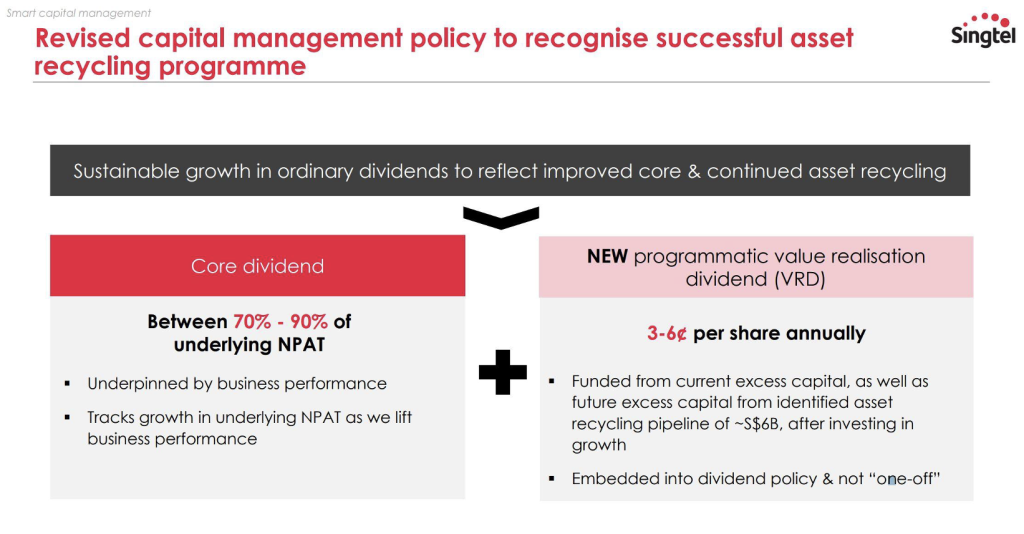
Singtel’s Value Realisation Dividend (VRD) Policy is a dividend framework that aims to distribute a portion of the value realised from its assets to shareholders. Hooray!
In the past, Singtel paid a core dividend of between 70% and 90% of underlying net profit, which grew as business performance improved.
Now, Singtel will pay an additional value realisation dividend of 3 – 6 cents per share per annum over the medium term. This is on top of the core dividend and funded by excess capital generated from asset recycling proceeds after investing in growth initiatives.
The first VRD will be paid in two tranches of 1.9 cents per share each in August 2024 and December 2024. I guess this is one of the key reasons that lifted up Singtel’s share price this year. Below is the history of Singtel’s dividends.

* The FY23 special dividend was paid in two tranches of 2.5 cents each, together with the core dividends in December 2022 and August 2023.
** The FY24 value realisation dividend will be paid in two tranches of 1.9 cents per share, together with the core dividends in August 2024 and December 2024.
This seems to create some unique investment propositions for Singtel shares:
- Meaningful earnings growth. (Singtel has guided for its EBIT (ex associates) to grow high single digit to low double digits in FY25)
- Higher dividends.
- A compelling blend of growth and yield.
Mitigating Risks and Challenges
When I asked, “What are the primary challenges or risks you foresee in executing ST28, and how is Singtel preparing to mitigate them?” Siok Hoon identified 3 key challenges:
- Geopolitical tensions.
- Rapid technological changes.
- Capital-intensive investments.
She also shared that Singtel will address these risks through:
- Strategic partnerships.
- Investing in growth engines.
- Prudent resource allocation.
There are a lot of more insights throughout the interview and I strongly encourage you to watch the recording here.
Let me Summarise…
To be frank, I had concerns about Singtel’s ability to adapt to disruption in the telecom industry. One notable instance was their exploration of regulating OTT services like WhatsApp.
I am glad that Singtel is embracing the new digitalisation world and moving the growth driver to IT services and Data Centres. Both are poised for significant expansion.
With its strategic reset, asset recycling, and focus on ST 28 plans, Singtel has made a stunning turnaround and is moving from reset to revival.
The increase in the dividend in May was likely the catalyst that sparked the market’s rerating in Singtel shares.
But even with the recent rally, Siok Hoon emphasised that Singtel’s current share price does not reflect its intrinsic value. With the company’s strong fundamentals and growth prospects, I agree that Singtel is an attractive investment opportunity for those seeking a combination of growth and income.
As Siok Hoon put it in her key message to the investors, “Investing in Singtel means you are choosing a blend of growth and yield, the best of both worlds.”
What are your opinions about Singtel’s Strategic Reset and ST 28 plans? Comment below and discuss. If you enjoy this article, subscribe to our newsletter below or join our Telegram Channel for future insights.
Disclaimer: At the time of writing, the author owns Singtel shares. The interview was conducted in August 2024.