


Have you been watching the markets lately and wondering what’s going on? The global market has been a rollercoaster—up one day, down the next. What’s really driving this turmoil, and more importantly, how can you navigate it? If you’ve found yourself asking these questions, you’re not alone. In this article, I’ll break down the key events that led to the recent market reset and share practical insights on how you can turn this chaos into opportunity. Ready to dive in? Let’s get started.
First, let’s get one thing straight about investing. You often hear people talk about market movements due to factors like US jobless claims, recession fears, inflation data, or company earnings reports. But here’s the truth: many just echo what they hear without really understanding it or checking its accuracy.
Most people focus on the details and miss the bigger picture. The key to investing isn’t just a company’s earnings forecast or a piece of economic data—it’s the market itself. And what is the market? It’s people. So, in essence, you’re investing in human behavior.
Sure, earnings and economic data influence market sentiment, but it’s human psychology—greed and fear—that truly drives market movements. That’s why Wall Street has a saying: “This time is different” is usually wrong. Human behavior has been the same for thousands of years. If something seems new to you, it’s probably because you haven’t seen enough financial history, and people call that “black swan event”.
A Black Swan Event?
Viewing the market through this lens changes your perspective. Take the failed assassination attempt against former President Donald Trump on July 13th. It was clear to me that this would shake things up, injecting a wave of uncertainty into the market. Why? Because Trump’s odds of winning the election skyrocketed, and a Trump presidency signals significant change to the financial market.
As I mentioned in our Telegram channel, this event reminded me of the 319 incident—the assassination attempt on former Taiwanese President Chen Shui-bian.

History Doesn’t Repeat Itself, but It Often Rhymes. The 319 incident, also known as the March 19 shooting incident, occurred in Taiwan on March 19, 2004, just one day before the presidential election.
During a campaign event in Tainan, an assassination attempt targeted President Chen Shui-bian and Vice President Annette Lu. Both sustained non-life-threatening injuries.

The incident’s impact on the election remains a topic of debate today, but one thing is for sure, Chen and Lu won the election by 29,500 votes and that had a lasting impact on Taiwan’s history, and the Trump event had a similar effect on market expectations.
The “Trump Trade”
This assumption of a Trump presidency triggered a market reaction, often called the “Trump Trade.” The biggest shift occurred in interest rate expectations. Trump is known for favoring lower interest rates to stimulate the economy, and he has strong views on issues like China and the Russia-Ukraine war. The market began quickly adjusting asset prices, leading to a rapid drop in US interest rates.
Since interest rates anchor all asset pricing, it’s no surprise that the market started repricing everything—stocks, bonds, and commodities.
Japan Adds Fuel to the Fire
But what really threw the market into a tailspin was Japan’s decision to raise interest rates. On July 31, 2024, the Bank of Japan (BOJ) raised its benchmark interest rate by 15 basis points to 0.25%. This was only the second hike since 2007, and while expected, the timing was peculiar.
For the past three years, the US has been hiking rates, pushing them higher across the board—except in Japan. Japan defied the trend by keeping its rates steady, leading to a sharp depreciation of the yen against the dollar. You’ve probably noticed the surge in tourists to Japan, and maybe you were among them. So much so that the town of Fujikawaguchiko even built a barrier to block a popular photo spot of Mount Fuji.

So why did the BOJ raise rates just as the dollar was weakening and the yen was expected to strengthen? The timing seemed more than coincidental. In any case, this marked a tipping point in the market, reversing the yen’s depreciation trend.
Why Does the Yen Carry Trade Unwind Matter?
To grasp the significance, you need to understand “carry trades.” Imagine borrowing money in a currency with a low interest rate, like the yen, and using that money to buy assets in a higher-yielding currency, like the US dollar. You earn interest on your investment while paying minimal interest on your loan. Plus, if the yen keeps weakening, you repay your loan with cheaper yen. It’s a double win.
The yen-dollar carry trade was attractive and popular—so much so that everyone was doing it. But everybody knows the underlying risks because it is such a crowded trade. Picture a crowded theater where everyone’s enjoying the show but also eyeing the exit, knowing a fire alarm could go off at any moment.
The BOJ did signal that they would raise the rate and reverse this trend, but all turned out to be false alarms. Since the Fed started hiking interest rates in March 2022, the Japanese Yen depreciated from around 115 JPY per Dollar to as high as 160 JPY per Dollar, a whopping nearly 40% depreciation!
Calling a stronger JPY becomes a carrying wolf and this leads to complacency in the market. People seem to think this will last forever.
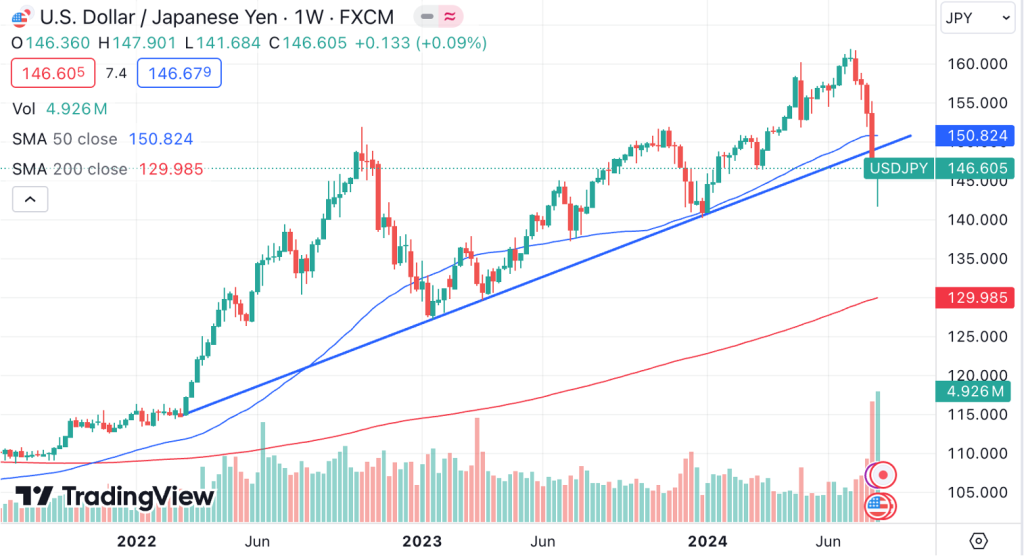
But when the reality of a Trump presidency and the BOJ rate hike set in, everyone rushed for the exits. And as you might expect, this triggered a stampede.
Carry trades work well when the yen is weak and the dollar strong. But when the yen strengthens, investors face losses as they must repay loans in a more expensive currency. This leads to a selloff in global markets.
The size of these carry trade positions was worth over US$14 billion in notional terms, according to CFTC data. Unwinding these trades involves selling dollar investments, converting dollars back to yen, and paying off loans, which creates a vicious cycle of selling, margin calls, and more selling.
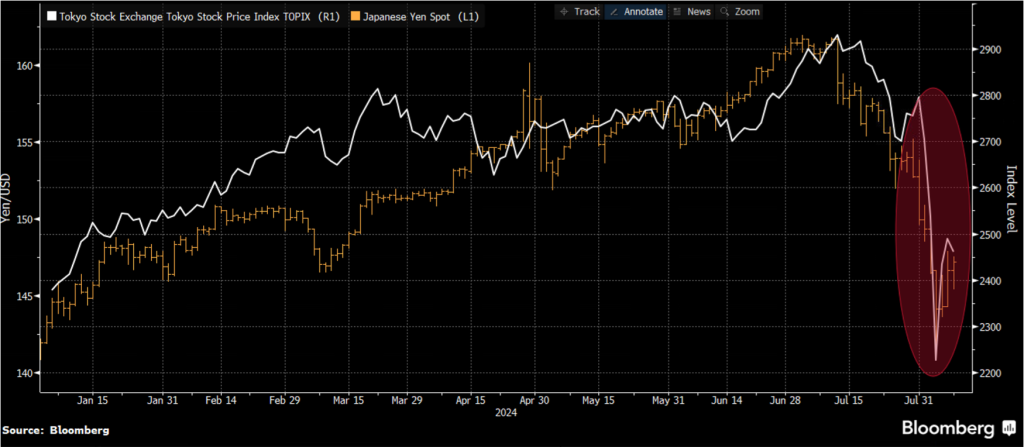
In fact, the volatility caused by the JPY USD carry-trade unwind is more severe than all the past crises.

What is Next?
According to a JPMorgan report, three-quarters of the global carry trade, roughly $10 billion worth of positions, has now been unwound over the past few weeks. This explains the financial avalanche we witnessed.
The good news? This means the short-term risk is mostly behind us. I see this as an excellent opportunity.
Remember, the market is driven by fear and greed. The yen’s surge disrupted one of this year’s most profitable trades, but the carry trade blowup wasn’t a total surprise. Savvy investors understood the risks but were betting on continued low volatility.
Right now, fear is in the driver’s seat. Warren Buffett’s wisdom to “be greedy when others are fearful” is often quoted but not easily followed. To act on it, you need a clear understanding of global macro trends, monetary policy, and the geopolitical landscape.
The recent events confirm my earlier suspicion that many macro trends are reversing, something I highlighted to our FRM Members during our Market Insight webinars.
Rate Cuts on the Horizon
Let’s face it, a US rate cut is on the horizon. The market is already anticipating a 0.5% cut in September, possibly followed by another two 0.25% cuts by year’s end. This could signal the end of the historically long inverted yield curve and the onset of normalization. As the chart shows, the difference between the 10-year and 2-year Treasury yields is closing in on zero. That means the “inverted yield curve” era may be soon over.
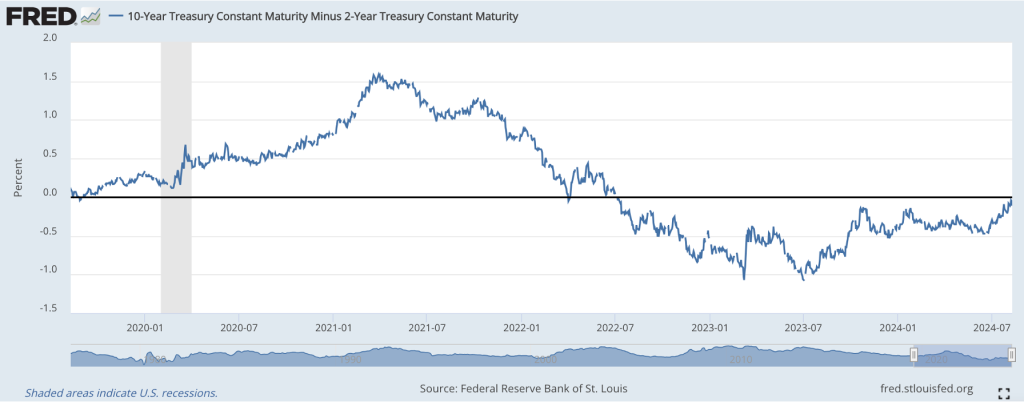
If this continues, a US recession is likely. The market was probably spooked by this too. Because historically, when the inverted yield curve normalizes, a recession follows. However, a recession and a stock market crash are two different matters. As the chart shows, there have been instances where the market didn’t crash after the first Fed rate cut, and returns were mixed.

But Don’t Take Rate Cuts for Granted
For those of us with long experience in the financial markets, we know the Fed is prone to flip-flopping. So don’t go all in just yet.
One thing I’ve learned over two decades in finance is that the market rarely moves as expected. The recent margin calls in the US and Japan, as well as the turmoil in the JPY currency market, are a testament to this. Markets often turn when people least expect it.
Don’t Underestimate Japan’s Market Influence
As I highlighted in our recent FRM meeting, Japan is the largest holder of US Treasuries, holding approximately $1.15 trillion as of April 2024. Movement of Japan’s financial market such as the unwinding of yen carry trades can easily send shockwaves to the global market.
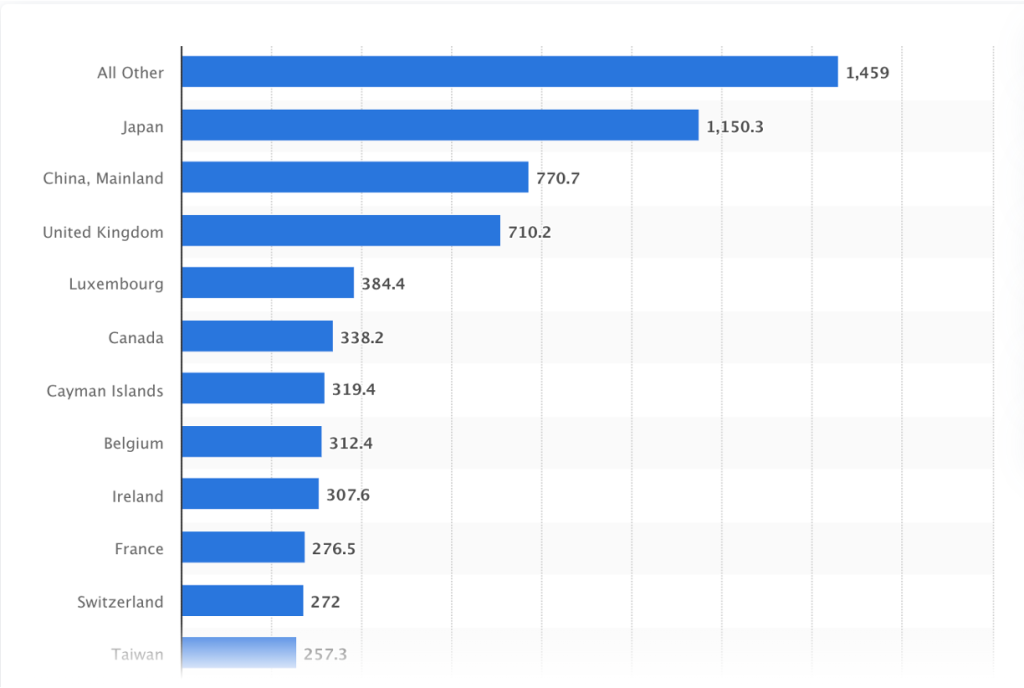
Although the Bank of Japan sent a strong dovish signal after the turmoil, pledging to refrain from hiking rates during market instability. I believe once the markets stabilize, the BOJ will signal the next rate hike again.
With higher interest rates in JPY and lower rates in USD on the horizon, we can reasonably expect a weaker dollar—a scenario Trump likely welcomes. This could be a good opportunity for certain sectors of the equity markets.
Let Me Summarize…
The recent market turmoil was mainly caused by the unwinding of yen carry trades, triggered by shifting interest rate expectations and the BOJ’s rate hike. While short-term risks have mostly subsided, uncertainty remains. However, this uncertainty also creates opportunities for those who understand the underlying dynamics.
Do you agree that successful investing is about understanding not only financial data but also human behavior and market cycles? Join our Telegram Channel to discuss.
If you want to stay ahead of the curve and gain more insights into future market trends, I invite you to join our FRM membership, where we provide timely market insights and discussions.