


Saturday morning, I rolled out of bed, grabbed my coffee, and did my usual market check. A sea of “red bars” immediately caught my eye. The S&P 500 had dropped 2.7%, and the Nasdaq Composite fell 3.6% — turn out the market just had the worst day since April. My first thought? “Okay, what happened now?”
A quick news scan summarized it in one line: President Trump announced a 100% tariff on Chinese imports and export controls on critical U.S.-made software, escalating trade tensions with China.
Naturally, I scrambled for the news. If we were to summarise it in one sentence, President Trump announced a 100% tariff on Chinese imports and export controls on critical U.S.-made software, escalating trade tensions with China.
But if you’ve been following my blog, you know I don’t just accept headlines at face value. I like to dig deeper, and here’s what I found.

What Really Happened
On Friday, President Trump made two big announcements:
A 100% tariff on China, on top of existing tariffs
Export controls on critical U.S. software, starting November 1
This came just hours after he threatened to cancel a meeting with Chinese President Xi Jinping.
Trump justified this as retaliation against China’s moves: new port fees on U.S. ships, an antitrust investigation into Qualcomm, and restrictions on rare earth and other critical material exports.
China, unsurprisingly, fired back. Their Ministry of Commerce said the U.S. should stop threatening tariffs, called for negotiations, and warned that they would retaliate if the U.S. persisted. From their perspective, these were defensive actions against new U.S. restrictive measures since September’s Madrid talks.
It wasn’t just the stock market that reacted. Over $19 billion in crypto positions were wiped out, and 1.6 million traders were liquidated in just 24 hours, with $7 billion gone in less than one hour on Friday.
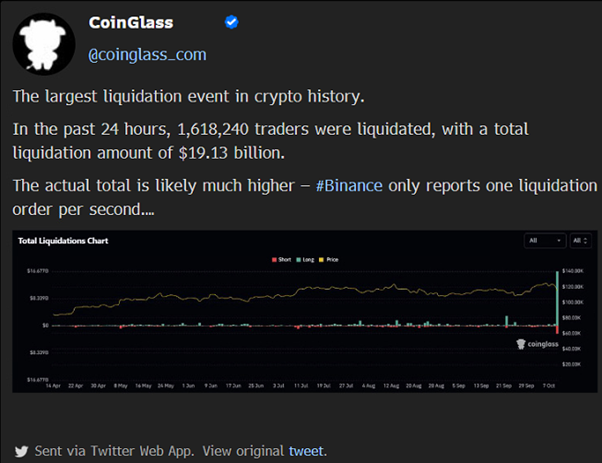
We can see cleary that investors rushed to de-risk, and volatility spiked sharply, a reminder of the market crash after the April “liberation day” just six months ago.
My Take
Here’s how I’m looking at it:
First of all, the market correction is no surprsing to me. This is what I wrote in my last month’s client report.
U.S. equities look stretched, trading at nearly 27 times earnings compared to a long-term average of 16 to 17. While the U.S. still offers global leadership in innovation, the elevated valuations and political uncertainties argue for a more cautious stance…
I don’t see major risks until end of the year, but I wouldn’t be surprised that if there is a heightened volatility triggered from the US markets. – Ivan Guan
If you look at the 6-month performance chart of Gold and S&P 500, it was just concerning. I knew the market was brewing something, and many investors have just become too complacent with the recent gains in their portfolio.
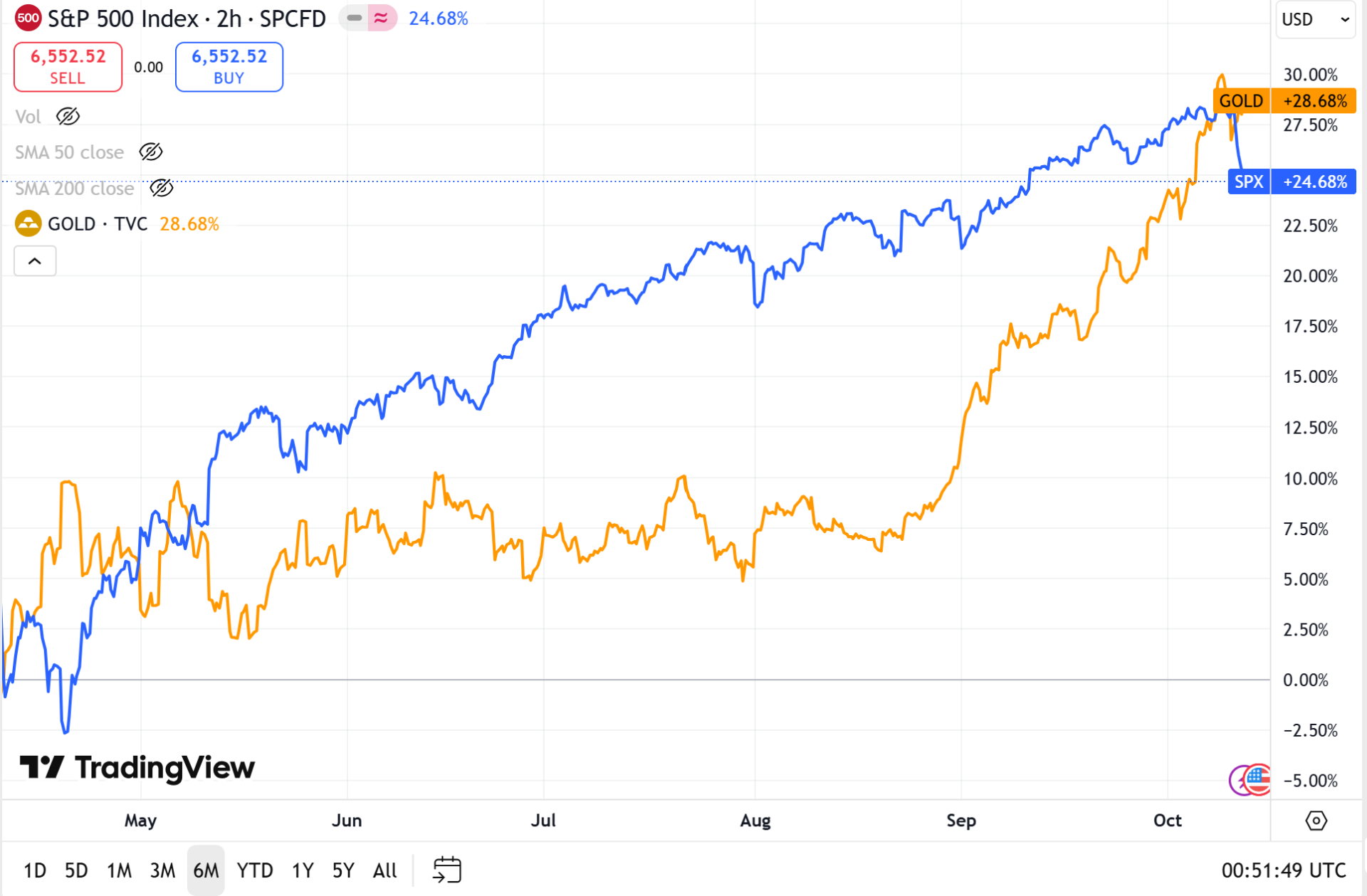
Secondly, if we take a stepback, I don’t think this was panic selling, yet. The market may just needs a reason to take profits, and this gave it one. I had already warned my clients that a correction is inevitable, and it was better to take the profits before the crash than after the crash.
Thirdly, let’s be real — the 100% tariff is mostly symbolic. U.S. tariffs on China are already around 50%, so most sectors that would feel the impact are already affected. Even Trump himself may not be confident about fully enforcing it.
Since he’s set the deadline for November 1, my expectation is that Trump will wait for China to respond with some sort of offer. China will probably say “no” at first, push back hard, but eventually, some compromise will be reached. When that happens, the tariffs will likely be reduced or even reversed, tensions will ease, and the market will calm down — probably celebrating as if nothing happened.
At the end of the day, fundamentally, nothing has really changed. The only thing that feels a bit overheated right now is the AI hype, but honestly, that’s just normal market behavior. Think of it like the Dot-com era — without the bubbles, we wouldn’t have seen the big market gains that followed.
What You Can Do
Personally, I see this as an opportunity rather than a threat. Short-term volatility drives long-term returns. For disciplined investors, these dips are moments to replenish equity exposure — as long as you stick to your plan and don’t over-leverage.
The biggest mistake most people make is trying to predict exactly when the next pullback or correction will hit. The truth is, it usually comes when you least expect it — and when that happens, many just freeze, too scared to take any action, even if they “predict” it correctly.
As a Global Momentum investor, I adovcate focusing on mid-term secular trends rather than getting caught up in daily market noise. Since there’s no way to predict exactly how low prices might go in the short term. The key is to follow a systematic approach:
- Global diversification — don’t put all your eggs in one basket. Move beyond a single market, whether it’s the U.S. or Singapore, and build a globally diversified, multi-asset portfolio.
- Momentum-driven positioning — allocate capital to regions, sectors, or assets that are showing strong relative momentum, so your money is riding the trends instead of fighting them.
- Dynamic risk management — trim or hedge positions when momentum fades or markets appear overextended. Protect your downside without overreacting.
- Opportunistic rebalancing — take profits when markets run up (like we recently did with U.S. exposure) and redeploy capital into undervalued regions, sectors, or bonds.
Final Thought
This episode of tariff talk is a reminder that politics will always influence markets. But our job as investors is not to predict policy, but to prepare for uncertainty.
When you stay invested with a balanced, globally diversified portfolio, corrections are opportunities, not threats. Stay calm. Stay focused. And stay on the path to retire rich.
If you want to stay ahead of the markets and get actionable insights every week, subscribe to my Retire Rich Newsletter. I’ll share practical strategies, market updates, and investment ideas — all designed to help you build wealth and secure your retirement.