


Recent news in Singapore is buzzing with excitement over new launches. Some of the hottest headlines right now include:
- Freehold Meyer Blue condo sells half of units at average price of $3,260 psf at launch
- Kingsford sells 76% of Chuan Park units at an average price of $2,579 psf
- CDL’s Norwood Grand sells 84% of units at $2,067 psf at launch
- Emerald of Katong draws 10,000 as crowds surge at project sales galleries during Deepavali weekend
Updated Nov 14: The balloting of Emerald of Katong (EOK) just ended. The cheque count (the number of people who registered for the first day sale) was 3,629.
Out of which, VIP, agent and bulk (multiple) purchases added up to 589.
Note there are only 846 units in EOK. It is going to be a chaotic weekend on the first sale day on Nov 16. Good luck!
While I am not a real estate agent and do not provide property purchase analysis, I do monitor the property market closely from a financial perspective. The property market is a fundamental component of the economy, and its movements reflect the overall market trends. If you recall, we just held an insightful webinar to offer on-the-group property market updates.
In this article, I will examine
- How the new launches affect the property market.
- Is there a direct link between the rate cut and the property prices?
- What home buyers should pay attention to in the current market.
Let’s dive in…
Chuan Park and Emerald of Katong: The Highlights
In recent days, Kingsford sold 76% of Chuan Park units at an average price of $2,579 psf. Astonishingly, Chuan Park attracted over 20,000 visitors during the preview period, with more than 2,800 cheques collected as expressions of interest. Note that Chuan Park has only 916 units, meaning there were potentially three buyers for every unit.

Of course, some people queue for fun or at multiple launches, but this still stirs excitement in the market. By the percentage of units sold, Norwood Grand, launched in October, leads with 84% or 292 out of 348 units sold.
Meanwhile, Emerald of Katong is generating significant hype due to its attractive indicative pricing. There’s a lot of analysis available online, so I won’t delve too deep here.
Do note not all new launches were as successful. For example, Union Square Residences only sold 20% of units at S$3,200 per square foot, and The Collective at One Sophia reached only 10% of sales.
I think this means buyers are selective even though there is steady demand in the market.
Is the Rising Property Price Due to Fed Rate Cuts?
Conventional wisdom says the US Federal Reserve’s rate cuts ripple through global markets, including Singapore. Many people attribute the rising property prices to the rate cut or expected rate cut. The current two-year fixed mortgage rate is between 2.5%-2.7%, down from over 4% in early 2023. Many predict this will bolster demand for new transactions. However, a lower interest rate environment does not necessarily push property prices higher; you need a deep understanding of the market.
Additional Reading: Fed Rate Cut: What is Next?
Bloomberg projects a 3% annual rise in home prices for both 2024 and 2025, following a similar trend in 2023. If we check the data, the property price uptrend resumed after a 0.7% drop in Q3 2024 prices, the first since Q2 2023, likely due to cautious sentiment before the Fed rate cut.
As interest rates fall, we can reasonably expect interest in buying property to pick up again. But does this mean property prices will continue to rise?
In even 2023, when people expected lower interest rates, I anticipated a “higher for longer” rate environment. I wrote an article titled “Will Singapore Property Prices Continue Going Up in 2023?” I called Singapore’s property market a “grey rhino.” I explained the demand drivers behind Singapore’s booming property market, highlighted the risk of rising interest rates, and cautioned against rushing into the market.
Turn out I was only half-right.
I was correct about the interest rates direction, but not the property prices. Despite continued interest rate hikes and higher Additional Buyer Stamp Duty introduced in April, property prices seemed unstoppable.
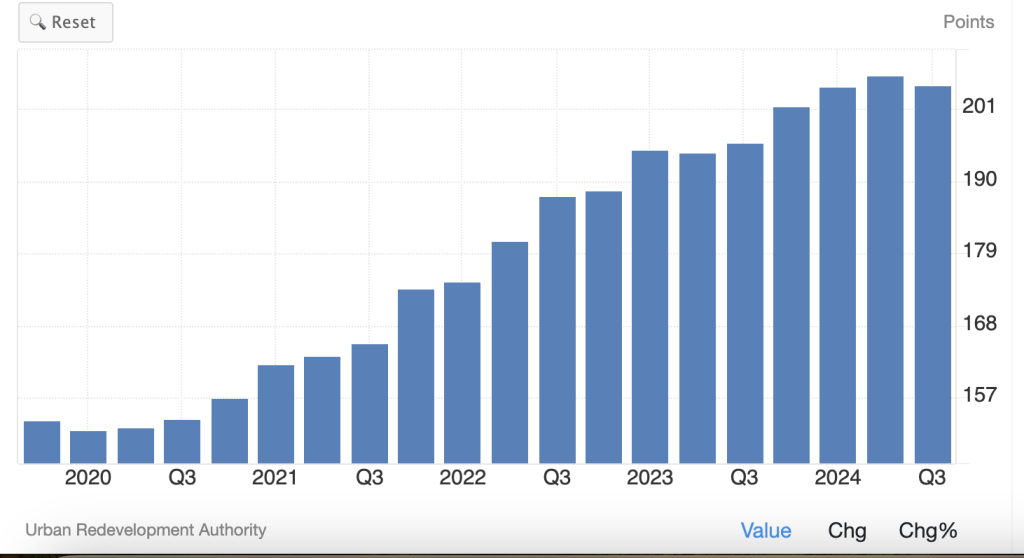
For comparison purposes, Singapore REITs dropped another 15% for the same period, reaching the same level as the worst time of COVID-19 in March 2020.
My point is that interest rates do affect the property market, but they are not the only factor. In Singapore, demand and supply dynamics outshine the impact of interest rates.
Residential Properties Hold Appeal as Inflation Hedge
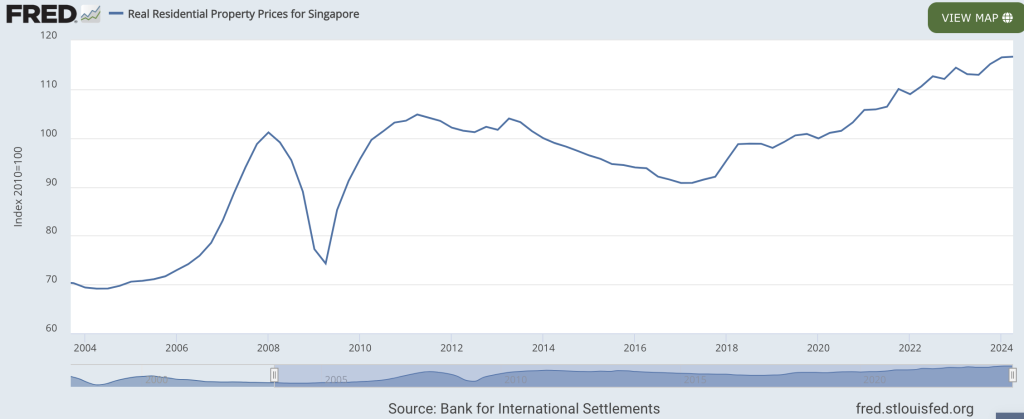
As far as I observe, Singaporeans view real estate as a store of value and an inflation hedge. The chart below shows the historical trend of Singapore’s inflation rate and home price increases. Home prices largely track inflation since 2000.
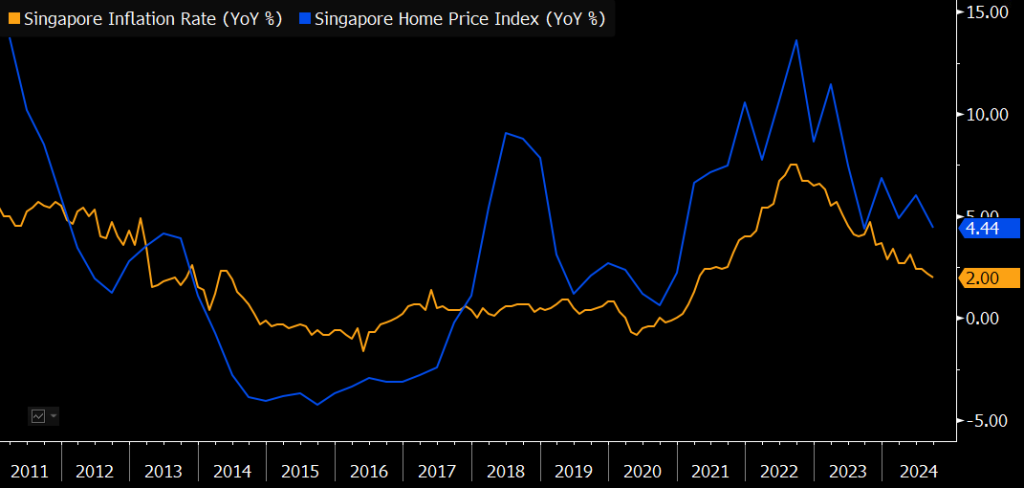
When discussing historical prices, it is essential to consider the period of 2013. During this year, there was a significant boom in new property launches, with many developments selling out completely on the first day. However, this was followed by a sluggish property market, resulting in properties only breaking even after seven years.
The Role of New Launches
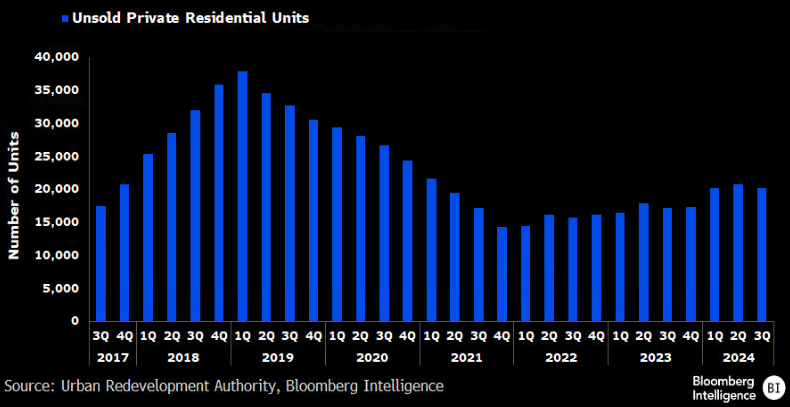
Today’s market is not as hot as 2013, and there are still plenty of supplies, with more than 20,000 unsold private residential units. These seem to be from older launches, while new launch take-up rates look healthy. We can see from the chart below that the number of unsold private resident units remain stable in the past 3 years.
The chart below shows the monthly new-home launches vs the number of sales. While demand remains healthy, I believe the surge of launches in mid-2023, and their staggered reintroduction in late 2024 will balance the market. The influx of new launches could potentially cap price growth.
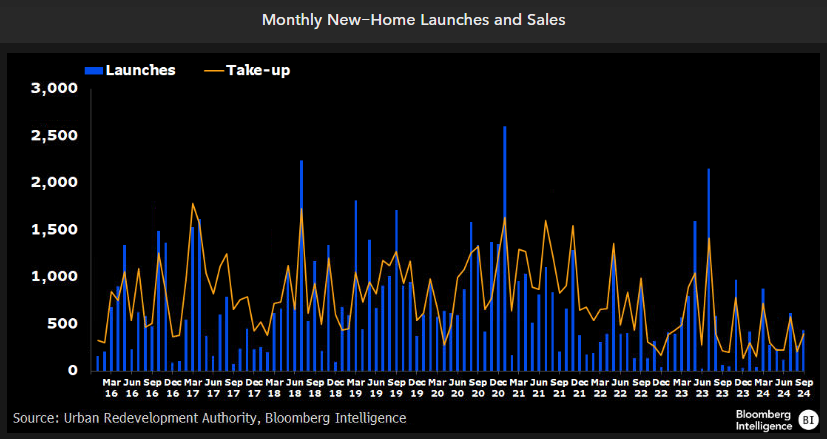
September 2024 long saw 401 units sold, the third-best month for sales this year. This indicates that well-timed launches are well-received. Indeed, many developers have held units, and recent crowded launches show they want to capture the market while sentiment is strong.
We have explained earlier this sentiment is driven by the expectation of a rate cut, leading many to believe it is an opportune time to enter the market.
Buyers are Selective
The current inventory of unsold private residential units in Q3 2024 is below the 10-year average, which might support prices through 2025. However, if unsold inventory rises significantly with more launches, we may see downward pressure on prices.
The chart below shows the price gap between new sales and resales in CCR (Core Central Region), RCR (Rest of Central Region), and OCR (Outside Central Region). The way I see it, the gap is well spread and proves that the market is very efficient.
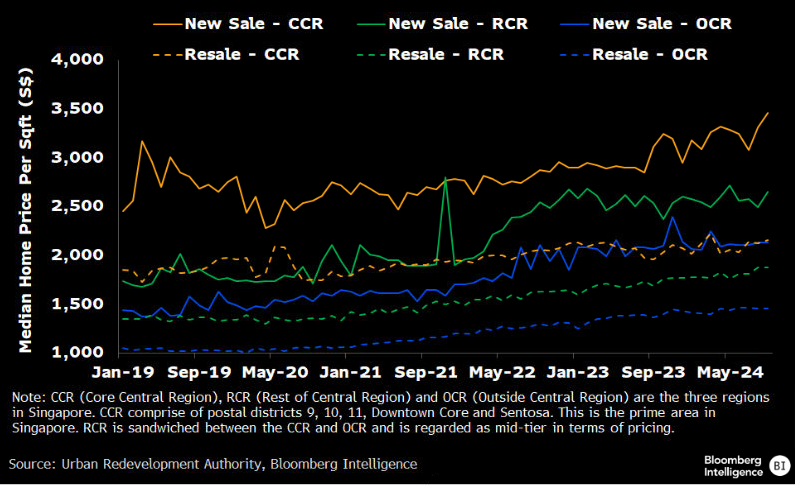
Today, with technology, regulation, and many readily available tools, the property market is efficient and transparent. I do not foresee a property bubble but I want to emphasize the importance of buyer selectivity.
Some people say it is a buyer’s market and some people say it is a seller’s market now. The way I see it, it’s no longer about a good or bad property market but about choosing projects with potential from an exit plan perspective.
In Summary…
As Trump prepares for his presidency, I’ve outlined its potential impact on the financial market in another article here.
Additional Reading: Trump 2.0: What Trump’s Victory Means To You.
In a nutshell, we will likely to see an inflationary environment and potentially higher for longer interest rate environment. Therefore, if you are betting that a rate cut will boost property prices, this view may be overly simplistic.
The outcome in Singapore’s property market will depend on a delicate balance of supply, demand, and broader economic conditions. A widening gap between the private property market and the HDB market will exert upward pressure on HDB prices. Additionally, given the Singaporean government’s commitment to maintaining the affordability of HDB flats, I won’t be surprised if new property cooling measures to be introduced in the near future.
The year 2024 has witnessed a vibrant wave of new property launches, with over 40 projects in the pipeline, offering more than 12,800 units. November alone saw six new launches. With these new homes entering the market, along with existing inventory, property selection becomes of utmost importance.
My advice is not to approach buying property solely as a home purchase. Adopt an investor’s mindset, as this is likely to be one of the most significant expenditures in your life. Staying informed and keeping an open mind will be crucial in navigating these changes.
What is your view of the current property market? Comment below. If you liked this article, subscribe to our newsletter or join our Telegram channel for more insights.
Is there any statistics how many of the buyers of the new launches are buy for flips i.e. hold on till TOP to aell for a profit, and how many buy for own stay?
Hi Victor, I think the mix of buyers and investors varies from project to project.
A development with a good mix of large units in RCR and OCR will have more buyers buying for their own stay. A development with a lot of small units in a central location will have more investors buying for rental income or capital gain.
Today, the unit size is very small, a 4-bedder only has the size of what used to be a 2-bedder or 3-bedder. So for 2-bed units, the majority will be investors. For 4-bed and 5-bed units, most will be for own stay.