


This week, the Singapore government brought back something familiar—a tougher Seller’s Stamp Duty (SSD).
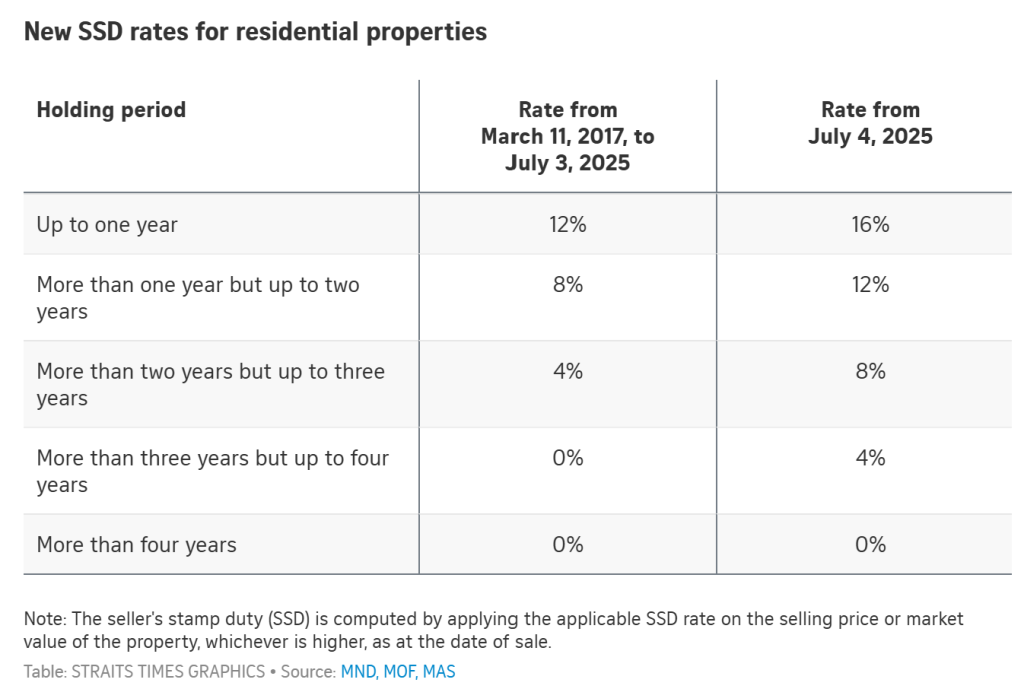
If you sell a private property within four years of buying it, you could now pay up to 16% in SSD, depending on how soon you sell. That’s up from the previous three-year window and 12% maximum.
These changes apply to all private residential properties purchased on or after 4 July 2025. HDB flat sellers will be unaffected due to the existing 5-year Minimum Occupation Period (MOP) rule.
The move is not a surprise to me. If you haven’t followed the property market recently, here’s the backdrop:
- Sub-sales surged: From just 178 in 2020 to over 1,300 in 2024, with many units flipped before completion.
- Short holding periods spiked: Especially in the 3–4 year window, where sellers were cashing out just as projects neared TOP.
- Interest rates are easing: Which could have reignited speculative demand if left unchecked.
As we all know, the Singapore government’s move is often a pre-emptive strike against speculative froth, not a reaction after a crash. At first glance, it may feel like another squeeze on property investors. But when you look closer, this isn’t just a clampdown—it’s reflecting the market fundamentals.

How should we interpret this news? Here is my analysis:
A Quick Look Back: SSD and the Cooling Measure Timeline
Let’s rewind a little.
SSD first entered the scene in 2010, right after the Global Financial Crisis. Prices were rising fast, and short-term flipping had become common. The government stepped in to cool speculative buying.
In 2017, SSD was softened. The holding period was cut to 3 years, and rates were lowered.
But now in 2025, we’re back to a full four-year hold and the maximum 16% rate. Why?
Because the past few years have shown signs of speculative fever again, especially after the pandemic, when supply disruptions and pent-up demand pushed prices higher.
But SSD is just one piece of the puzzle. Since 2009, we’ve had 16 rounds of property cooling measures in Singapore. Here is a recap:
| Date | Measure | Key Highlights |
|---|---|---|
| Sep 2009 | Removal of IAS & IOS | Ended Interest Absorption Scheme and Interest-Only Loans |
| Feb 2010 | First SSD + LTV cut to 80% | SSD for sales within 1 year; tighter financing |
| Aug 2010 | SSD extended to 3 years + LTV to 70% | Further dampening of speculative demand |
| Jan 2011 | SSD rates raised | Up to 16% in Year 1 sales |
| Dec 2011 | ABSD introduced | Extra duty for foreigners and multiple-property buyers |
| Oct 2012 | Mortgage tenure capped at 35 years | Lower LTV for long-tenure loans |
| Jan 2013 | ABSD & LTV tightened | Higher ABSD; reduced LTV for existing-loan holders |
| Jun 2013 | TDSR framework introduced | Capped debt servicing at 60% of income |
| Aug 2013 | EC resale levy & dual-key restrictions | Targeted at executive condo buyers |
| Jul 2018 | ABSD hike + tighter LTV | Further curbs on investors |
| Dec 2021 | ABSD increase + TDSR at 55% + HDB LTV 85% | Stronger stress tests and loan limits |
| Sep 2022 | TDSR interest-rate floor + 15-month wait | For private to HDB downgrades |
| Apr 2023 | ABSD for foreigners doubled (30→60%) | Harsher duty for non-citizens |
| Aug 2024 | HDB LTV cut to 75% + EHG enhanced | More prudent HDB financing |
| Jul 2025 | SSD raised to 4–16% + 4-year holding period | Latest measure to curb short-term flips |
What Do I Think About The New Measures
In one of my earlier articles in November 2024, I wrote about how 2024 was a blockbuster year for new launches. More than 40 private developments hit the market. Showrooms were packed. Buyers were rushing in, encouraged by developers, agents, and influencers promising upside.
The common playbook? – Buy early, hold three years, and flip for gains.
It worked—for a while. Since Covid-19, there have been huge delays in construction and many projects. This created a tight supply. At the same time, people aspire to have a bigger house due to the work-from-home requirements.
Prices were climbing, and yes—some investors walked away with handsome profits. But it also left genuine homebuyers, especially families with real housing needs, struggling to find affordable options.
Personally, I feel this SSD move may have come a little too late. The market momentum was already softening, and this measure might now feel more like a symbolic gesture than an effective one.
Here’s the data from EdgeProp, and you can clearly see that the momentum of property price growth has come down.
| Year | Private Home Price Growth |
|---|---|
| 2021 | +10.6% |
| 2022 | +8.6% |
| 2023 | +6.8% |
| 2024 | +3.9% |
That trend isn’t just a blip. It’s a natural trajectory. And when the music slows, those who bought without a plan could be left exposed.
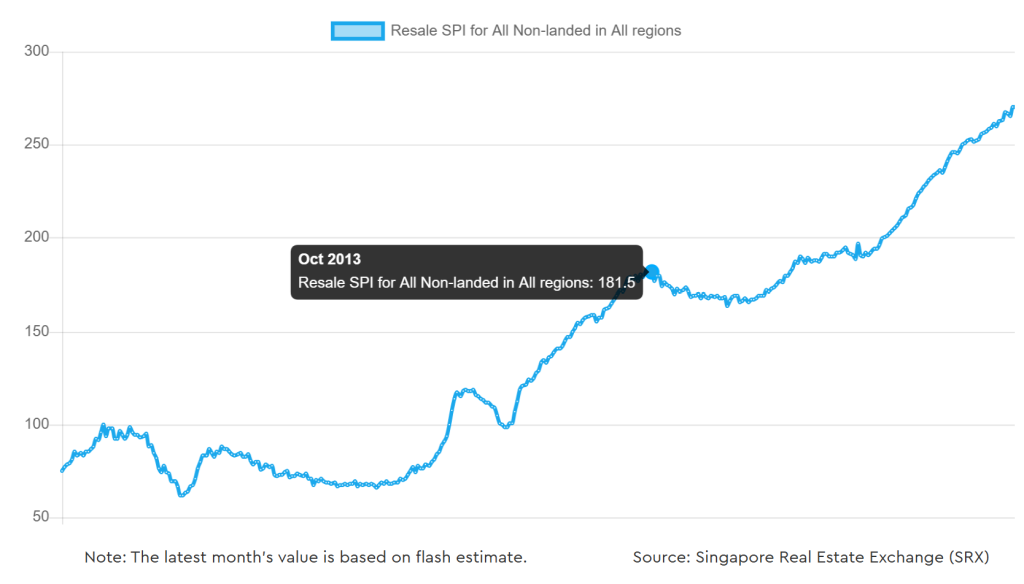
If you look at the non-landed private property index below, you can see the previous property peak was in 2013, 5 years after the global financial crisis (GFC) in 2008. And then it went to a 5-year consolidation before it reached the same level again in 2018.
I feel the same cycle is repeating if we take 2000 Covid-19 as a similar event to the GFC. The Singapore government’s policies are often ahead of the curve, and now it sends a strong message: the party’s winding down. It’s time to get back to fundamentals.
Here’s what I expect going forward:
- Developers may stagger their launches, knowing that quick resales are less attractive.
- Buyers who were banking on short-term gains may pause or re-evaluate their strategy.
- Investors with long-term plans and holding power will benefit from less competition and more stable fundamentals.
Property: A Layer in the Kueh Lapis, Not the Whole Cake
If you’ve followed my writing, you’ll know I always talk about Kueh Lapis Framework for layering your wealth.
- The guaranteed layer is your foundation: CPF, bank savings, and insurance plans. These are safe, liquid, and predictable.
- The variable layer could include property, but only when it aligns with your long-term goals.
Don’t get me wrong. Property investment is an important Income-Generating Asset (IGA) if you want to retire well. It offers rental yield, inflation protection, and even a downsizing option in retirement. But it’s also illiquid, heavily taxed, expensive to finance, and costly to maintain.

I’ve seen people pour 80–90% of their personal wealth into a single condo unit, hoping it’ll carry them through retirement. That’s a risky bet—not just because of market volatility, but because it concentrates your financial future on one immovable asset.
What if you face a medical or other emergency and need to raise cash quickly? What if rental income dries up during a downturn? What if you are retrenched or the economy suffers a prolonged downturn? With most of your wealth locked in a property, your hands are tied.
And let’s not forget the hidden costs—maintenance fees, property taxes, repairs, and interest rates. These can quietly eat into your retirement income, especially if you’re no longer working. The assumption that property will always appreciate or be easily monetized doesn’t always hold up, especially when timing works against you.
That’s why I say: don’t treat property like a magic bullet for retirement. It can be a great component of your long-term plan—but only when it complements your broader financial strategy.
What You Can Do Right Now
The latest SSB cooling measure is a good reminder to re-evaluate your financial plans before you make the next big move:
- Run the numbers before you buy – Make sure the mortgage, maintenance, and tax costs don’t strain your liquidity or derail your retirement planning.
- Consider liquidity – If something unexpected happens, how quickly can you exit? With SSD now back to 4 years, timing matters.
- Diversify your exposure – You can still invest in real estate without buying a whole unit. REITs, property bonds, and property funds offer diversification with less capital and more flexibility.
Make Decisions Based on Your Goals—Not Someone Else’s Highlight Reel
This new SSD isn’t a punishment. It’s a reminder—a chance to reset expectations.
It’s easy to get swept up in what you see on social media—flashy show flat tours, quick-flip success stories, and influencer “investors” flaunting gains. But your financial journey isn’t a popularity contest.
Property is still one of the most powerful tools for building wealth in Singapore. But only when you approach it with clarity, patience, and intention and focus on what aligns with your own goals, risk tolerance, and time horizon.
So before you jump into a new launch or plan your next move, ask yourself:
“Am I buying this property to fit my strategy—or forcing my strategy to fit the property?”
Trends fade. Your long-term plan shouldn’t.
If you’re feeling uncertain about how a property investment fits into your overall retirement planning, you don’t have to figure it out alone. Request a non-obligatory retirement discovery meeting with me using the form below for personalised, holistic financial planning.
If you like this article, stay ahead of market shifts and make informed decisions by joining my Telegram channel and subscribing to my Retire Rick Weekly newsletter.
Let’s build a financial future that’s intentional, resilient, and truly yours.